Digital Arrest Scam Explained: How It Works, Red Flags and What to Do (2026)
Cyber Safety 13 min read By Richa Singh
In this articleTable of contents12
Last updated: 10 October 2026
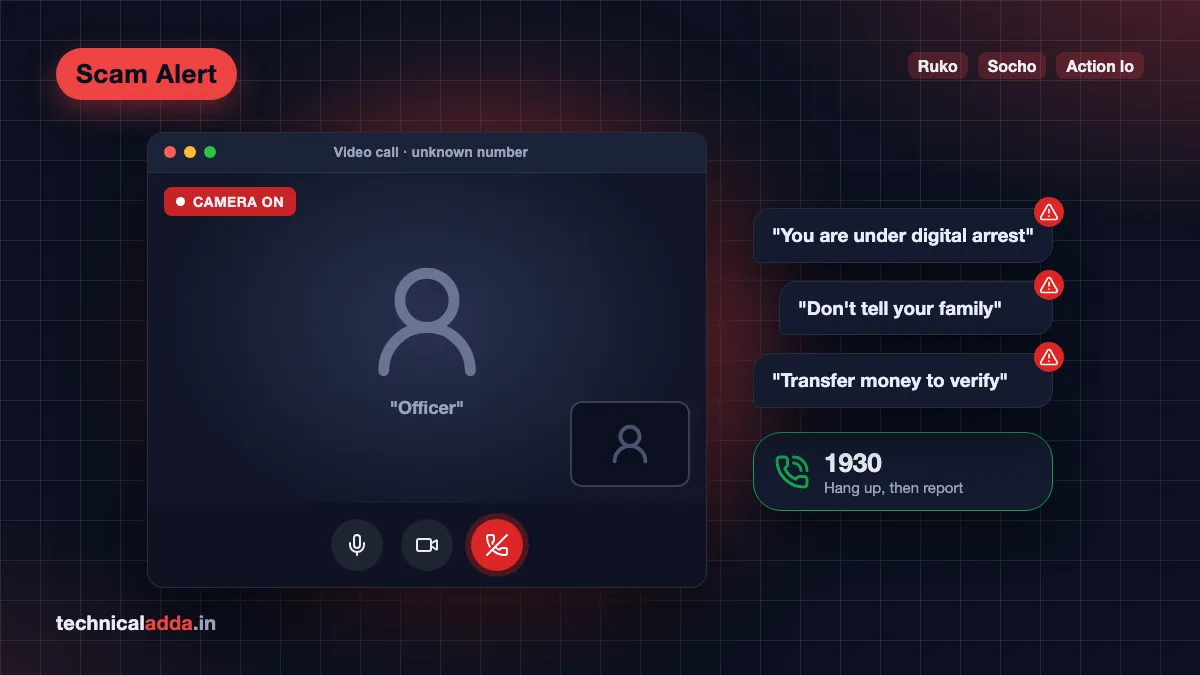
The call starts politely. "This is from the courier company. A parcel in your name has drugs and fake passports." Minutes later, a "police officer" in uniform appears on a video call, shows an "arrest warrant", and tells you that you are under digital arrest. You must stay on camera, tell no one, and transfer your savings for "verification". The digital arrest scam has cost Indians huge sums, from retired professionals to young engineers. This guide explains how the scam works step by step, what official government advisories say, the red flags to spot, what police, CBI and ED never do, and exactly how to report it.
Quick answer: A digital arrest scam is a fraud in which criminals pose as police, CBI, ED, customs, RBI or narcotics officers on phone and video calls, falsely accuse you of a crime, and keep you "under arrest" on camera until you transfer money. There is no "digital arrest" by real agencies. Disconnect, verify independently and report on 1930 or cybercrime.gov.in.
What is a digital arrest scam?
A digital arrest scam is an online extortion fraud. Criminals pretend to be officers of law enforcement or regulatory agencies and convince the victim that they are involved in a serious crime, such as drug trafficking, money laundering or identity misuse. The victim is then told they are "under digital arrest" and must stay on a video call, isolated from family, until they pay money to "settle the case" or "verify" their funds.
The key thing to understand: "digital arrest" is not a real legal procedure. It is a term invented by fraudsters to sound official. Genuine agencies do not arrest people over video calls.
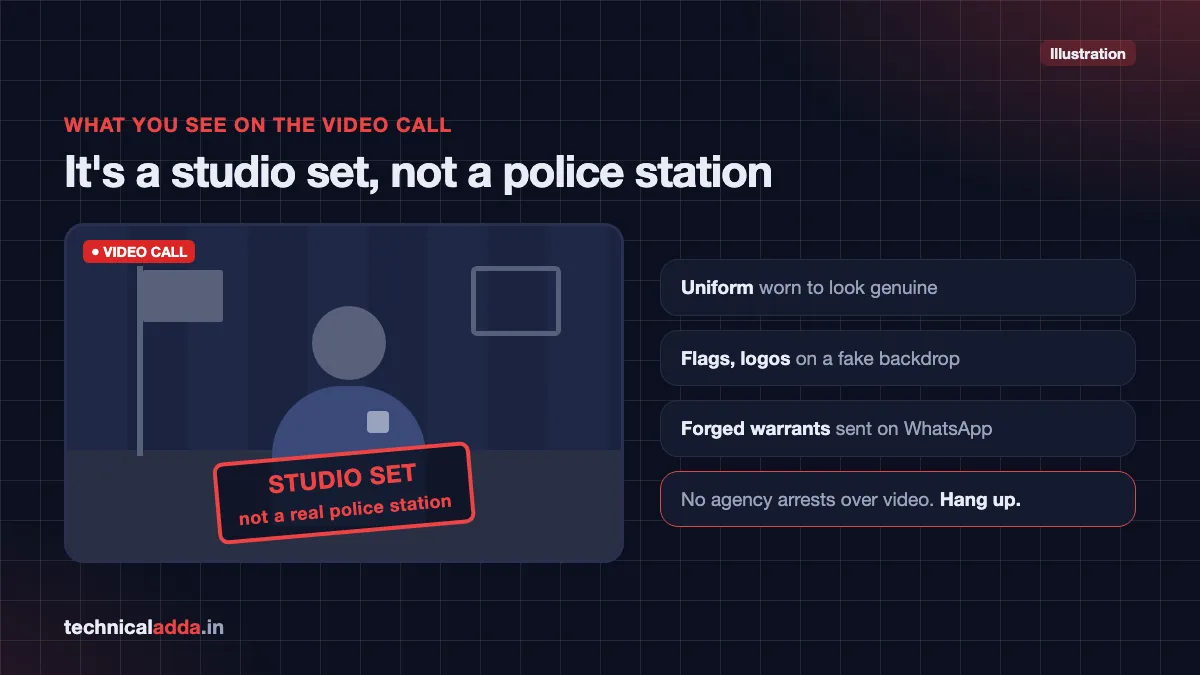
The Ministry of Home Affairs, in a May 2024 alert published by PIB (opens in new tab), described how fraudsters pose as officers of state police, CBI, the Narcotics Department, RBI and the Enforcement Directorate. It noted that they use studios modelled on police stations and government offices and wear uniforms to look genuine, and that the crime is run by cross-border crime syndicates.
How the digital arrest scam works: step by step
Most digital arrest cases follow the same script, designed to create fear, isolation and urgency.
Step 1: The hook call
You get a call or an automated voice message, often claiming to be from:
- A courier company ("Your parcel has been seized")
- TRAI or a telecom operator ("Your number will be disconnected for illegal use")
- A bank or RBI ("Your account is linked to money laundering")
- Customs or the Narcotics Control Bureau
The number may look Indian. Fraudsters have used international calls spoofed to display Indian numbers, which the government and telecom operators have since moved to block.
Step 2: The "transfer" to police
The caller says your case has been "forwarded" to the police, CBI or cyber cell and connects you to an "officer".
Step 3: The video call
You are asked to join a video call on WhatsApp or another app. Earlier, many such calls used Skype; Microsoft retired Skype in May 2025, so calls now come through other video apps. On screen:
- A person in uniform
- A police station-like background with logos and flags
- Sometimes a fake "senior officer" or "judge"
Step 4: The fake evidence
They show forged documents: "arrest warrants", "FIRs", "Supreme Court orders", "RBI letters" or "CBI notices", often with your real name and Aadhaar number, which they may have collected from data leaks.
Step 5: The "digital arrest"
You are told you are under arrest and must stay on camera. You cannot hang up, close the door, call family or tell anyone, because "the case is confidential" or "your family is also under watch". Some victims have been kept on such calls for many hours or even days.
Step 6: The money demand
To "prove your innocence", you must transfer your money to a "secure government account" or "RBI verification account" for checking. They promise to return it after "verification". Some victims are asked to break fixed deposits, sell investments or take loans.
Step 7: The disappearance
Once the money is transferred, it is quickly moved through mule accounts (bank accounts rented or stolen for fraud) and the callers vanish.
Common stories scammers use
| Script | What they claim | What they want |
|---|---|---|
| Courier / parcel scam | A parcel in your name with drugs, fake passports or contraband was seized | Money to "close the case" |
| Money laundering | Your bank account or Aadhaar was used in a money laundering case | Transfer savings for "verification" |
| SIM / telecom misuse | Your number is linked to illegal activity and will be blocked | Personal data, then money |
| Relative in custody | Your son/daughter/relative has been caught in a crime or accident | Immediate "settlement" money |
| Obscene content / blackmail | You watched or shared illegal content | Money to avoid "arrest" or "exposure" |
| Tax / customs | Unpaid customs duty or tax on a shipment | Payment of a "fine" |
The MHA alert specifically mentions the parcel story (illegal goods, drugs, fake passports or contraband) and the "relative in custody" story.
What the government and courts have said
MHA and I4C advisories
- In May 2024, the Ministry of Home Affairs issued an alert against "Blackmail" and "Digital Arrest" by criminals impersonating state police, NCB, CBI, RBI and other agencies, and advised citizens to report such calls on 1930 or cybercrime.gov.in.
- The Indian Cyber Crime Coordination Centre (I4C) issued a public advisory in October 2024 stating that agencies like the CBI, police, customs, ED and judges do not arrest people over video calls, as widely reported at the time. I4C's official Cyberdost account on X continues to repeat this warning and points victims to 1930 and cybercrime.gov.in.
- In a Rajya Sabha reply published by PIB in March 2025 (opens in new tab), the government said I4C had identified and blocked more than 3,962 Skype IDs and 83,668 WhatsApp accounts used for digital arrest. It also said more than 7.81 lakh SIM cards and 2,08,469 IMEIs reported by police had been blocked till 28 February 2025, and a system was built with telecom operators to block international spoofed calls showing Indian numbers.
- The same reply noted that the National Crime Records Bureau does not maintain separate data for digital arrest scams.
News reports citing government data have put losses to digital arrest scams in 2024 at around ₹1,935 crore, from about 1.23 lakh complaints. This figure is not in the PIB replies linked above, so treat it as a reported estimate rather than an official total.
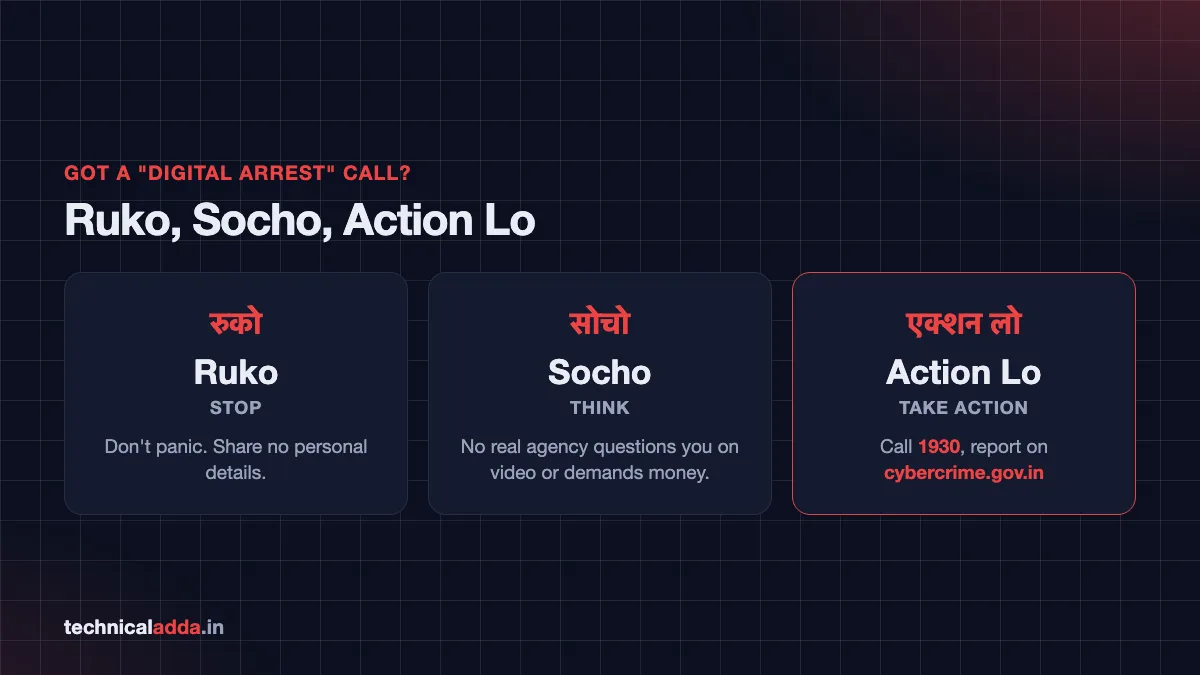
Prime Minister's "Ruko, Socho, Action Lo"
The Prime Minister spoke about digital arrest in Mann Ki Baat on 27 October 2024, as also noted in the PIB reply above. He shared a simple three-step mantra:
- Ruko (Stop): Do not panic. Do not share any personal details.
- Socho (Think): No genuine agency questions people like this over phone or video calls or demands money.
- Action lo (Take action): Call the national cybercrime helpline 1930, report on cybercrime.gov.in, inform family and police, and keep records.
Supreme Court action
On 17 October 2025, the Supreme Court took suo motu cognisance of digital arrest scams after a senior citizen from Ambala, Haryana, complained that fraudsters had used forged Supreme Court orders to extort money. On 1 December 2025, a bench led by Chief Justice Surya Kant directed the CBI to investigate digital arrest scams across the country. The court's orders are available on the official Supreme Court website (sci.gov.in).
Red flags of a digital arrest scam
If you notice even one of these, it is almost certainly a scam.
- You are told you are "under digital arrest" or "house arrest via video".
- You must keep the camera on and cannot leave the room or end the call.
- You are told not to tell family, friends or a lawyer because the case is "secret".
- You are asked to transfer money to any account for "verification", "safe custody", "bail" or "settlement".
- Official documents arrive on WhatsApp with stamps, logos and signatures that look impressive.
- The call starts from a courier, telecom or bank and then "transfers" you to police.
- Extreme urgency: "Pay within one hour or you will be arrested."
- They know your Aadhaar or PAN number. This only means your data has leaked somewhere; it does not prove they are officials.
- You are asked to install a remote access or screen-sharing app.
- You are asked to take a loan or break FDs to pay them.
Fraudsters may also use AI-generated or edited images of documents and officers. Our guide on how to detect AI generated images can help you spot fakes.
What police, CBI and ED never do
Based on official advisories, genuine law enforcement agencies:
| Real agencies never… | What actually happens |
|---|---|
| Arrest anyone over a video call | Arrests happen in person, following legal procedure |
| Keep you on camera for hours as "custody" | There is no such thing as "digital arrest" |
| Ask you to transfer money to "verify" funds | Agencies do not take money into personal or "verification" accounts |
| Demand secrecy from your family or lawyer | You always have the right to consult a lawyer and inform family |
| Send arrest warrants as WhatsApp images and demand payment | Legal notices come through proper channels and can be verified at the police station or court |
| Ask for your UPI PIN, OTP or net banking password | No agency ever needs these |
| Call from courier companies or telecom operators | Investigations do not start with a courier customer care call |
If you are ever unsure, hang up and call your local police station using a number you find yourself, or dial 112 for emergencies. A genuine case will still exist after you hang up.
What to do if you get a digital arrest call
While the call is happening
- Stay calm. Fear is the scammer's main weapon.
- Do not share Aadhaar, PAN, bank details, OTP or UPI PIN.
- Do not transfer any money, no matter what they threaten.
- Disconnect the call. You are not legally bound to stay on any video call.
- Do not install any app they ask for.
- Take screenshots of the caller's number, profile and documents if you can do so safely.
Right after the call
- Tell a family member or friend immediately. Scammers rely on isolation.
- Verify independently by calling your local police station or visiting it.
- Report the call (see next section).
- Block the number on your phone. Our guide on how to block spam calls on Android shows how.
- Check your phone for any app they may have made you install. Read how to check if your phone is hacked.
If you already transferred money
Every minute matters.
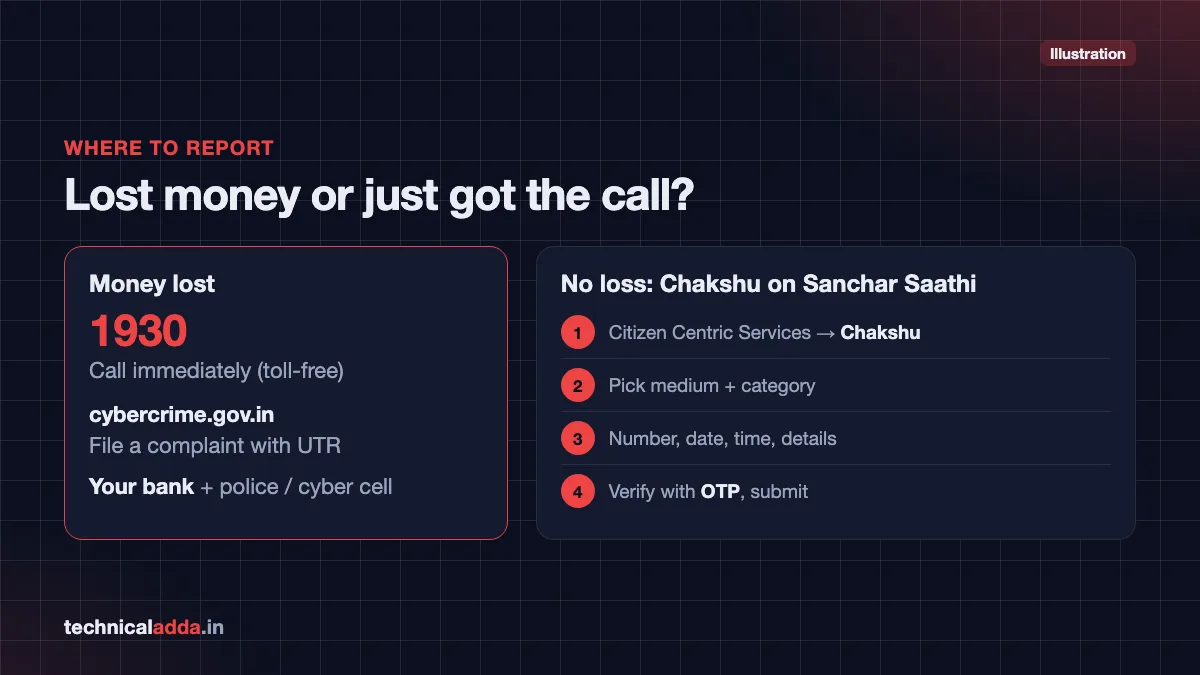
- Call 1930 immediately. It is linked to the Citizen Financial Cyber Fraud Reporting and Management System, which helps banks freeze fraud money before it moves further.
- Call your bank's official customer care and ask them to freeze or hold the transaction.
- File a complaint on cybercrime.gov.in with all transaction details.
- Visit your local police station or cyber cell and file an FIR.
- Keep all evidence: call logs, screenshots, transaction IDs (UTR), bank statements and documents they sent.
How to report a digital arrest scam
| Where | What to report | How |
|---|---|---|
| 1930 helpline | Financial loss or attempted fraud | Call 1930 (toll-free) |
| cybercrime.gov.in (opens in new tab) | Detailed complaint with evidence | Online form; choose financial fraud or other cybercrime |
| Chakshu (Sanchar Saathi) | Suspected fraud call/SMS/WhatsApp, even with no loss | On the Sanchar Saathi portal or app |
| Local police / cyber cell | FIR, especially for money lost | Visit with evidence |
| Your bank | Freeze or trace money transferred | Official customer care or branch |
Using Chakshu on Sanchar Saathi
The Department of Telecommunications' Sanchar Saathi portal (opens in new tab) has a facility called Chakshu – Report Suspected Fraud Communication. It is meant for calls, SMS and WhatsApp messages that attempted fraud, such as impersonation of government officials, even if you did not lose money.
- Open Sanchar Saathi (website or app) and go to Citizen Centric Services → Chakshu.
- Choose the medium (call, SMS or WhatsApp) and the category (for example, impersonation of government officials).
- Enter the number, date, time and details. Add a screenshot if available.
- Verify with an OTP on your mobile and submit.
If money was lost, Chakshu is not the right place. Use 1930 and cybercrime.gov.in instead.
Other useful Sanchar Saathi features
- Check how many mobile connections are registered in your name and report ones you do not recognise.
- Block a lost or stolen phone using its IMEI.
For a complete walkthrough of filing an online complaint, read our guide on how to report cyber fraud online in India.
How to protect elderly parents
Many reported victims are senior citizens, retired professionals and people living alone. A 10-minute conversation can protect them.
- Explain the scam in simple words: "Police never arrest anyone on video call. If someone says so, cut the call and call me."
- Agree on a family rule: No money transfer above a small amount without talking to a family member first.
- Save 1930 and the local police station number in their phone.
- Enable transaction alerts and, if they agree, add a family member as a contact with the bank.
- Show them examples of fake documents and studio sets from government awareness campaigns.
- Check in regularly, especially if they suddenly seem stressed, avoid calls or ask about large withdrawals.
- Teach them other common scams, such as fake payment screenshots. See how to identify a fake UPI payment screenshot.
Key takeaways
- "Digital arrest" is not a legal procedure; it is a scam that uses fake officers, fake documents and fear.
- Fraudsters pose as police, CBI, ED, customs, NCB or RBI and often start with a courier or telecom story.
- Real agencies never arrest over video calls, demand money transfers or ask you to hide the call from family.
- Follow "Ruko, Socho, Action Lo": stop, think, and report.
- If money is lost, call 1930 immediately, then file on cybercrime.gov.in and with the police.
- Report attempted fraud calls on Chakshu (Sanchar Saathi) to help block scam numbers.
Conclusion
The digital arrest scam works only because it creates fear, secrecy and urgency. Once you know that no police officer, CBI official or ED officer will ever arrest you on a video call or ask you to move money for "verification", the scam loses its power. Hang up, talk to family, verify with your local police, and report on 1930, cybercrime.gov.in or Chakshu.
Share this guide with parents and older relatives today. Next, read our step-by-step guide on how to report cyber fraud online in India, and find more safety guides in our Cyber Safety section.
FAQ
Frequently Asked Questions
What is a digital arrest scam?
A digital arrest scam is a fraud in which criminals pretend to be police, CBI, ED, customs, narcotics or RBI officials and accuse you of a crime over phone and video calls. They claim you are "under digital arrest", keep you on camera and isolated, and pressure you to transfer money for "verification" or "settlement". Real agencies do not do this.
Is digital arrest legal in India?
No. Genuine law enforcement agencies in India do not arrest anyone over a video call, and there is no procedure called "digital arrest". The Indian Cyber Crime Coordination Centre has stated that agencies like the CBI, police, customs, ED and judges do not arrest people through video calls. Anyone claiming to do so is a fraudster.
What should I do if I get a call saying I am under digital arrest?
Disconnect the call immediately and do not share any personal or bank details. Tell a family member, then verify by calling your local police station yourself. Report the call on the Chakshu facility of Sanchar Saathi or on cybercrime.gov.in. If you have already transferred money, call the cybercrime helpline 1930 without delay.
How do I report a digital arrest scam?
Call the national cybercrime helpline 1930 or file a complaint on cybercrime.gov.in. If money was lost, also contact your bank and file an FIR at your local police station or cyber cell. For suspicious calls or messages where no money was lost, use the Chakshu facility on the Sanchar Saathi portal or app.
Can I get my money back after a digital arrest scam?
It is possible, but speed matters. Calling 1930 quickly allows the Citizen Financial Cyber Fraud Reporting and Management System to alert banks, which can try to freeze money before it moves through mule accounts. Recovery is not guaranteed, and the process can take time through police investigation and court orders. Keep all transaction details and evidence.
Why do scammers know my Aadhaar number and address?
Scammers often get personal details from data leaks, phishing, fake forms or documents shared carelessly online. Knowing your Aadhaar, PAN or address does not mean they are officials. It is only a trick to make the call seem real. If you suspect misuse, check mobile connections in your name on Sanchar Saathi and lock your Aadhaar biometrics on UIDAI.
Do the CBI or ED send notices on WhatsApp?
You should not trust any arrest warrant, FIR or court order sent on WhatsApp along with a demand for money. Real legal processes are carried out through proper channels and can be verified with the police station or court concerned. If you receive such a document, do not pay, and verify independently with the agency's official contact details.
What is the "Ruko, Socho, Action Lo" campaign?
"Ruko, Socho, Action Lo" (Stop, Think, Take Action) is the three-step advice the Prime Minister shared in Mann Ki Baat on 27 October 2024 to fight digital arrest scams. Stop and do not panic, think about the fact that real agencies do not investigate over video calls, and act by reporting on 1930 or cybercrime.gov.in.
What is the FedEx or courier parcel scam?
The courier parcel scam is a common start to a digital arrest fraud. A caller claims to be from a courier company and says a parcel in your name containing drugs, fake passports or other illegal items was seized. They then "transfer" you to fake police or CBI officers, who threaten arrest and demand money. Real courier firms do not do this.
How can I protect my parents from digital arrest scams?
Talk to them about how the scam works and set a clear rule: police never arrest anyone on a video call, and no money should be sent without first speaking to family. Save 1930 in their phone, enable bank alerts, and check on them regularly. Encourage them to hang up and call you whenever a caller creates fear.