AI Skills to Learn in 2026: 10 In-Demand Skills, Free Resources and Roadmap
AI Careers 13 min read By Xavio Thomas
In this articleTable of contents10
Last updated: 10 October 2026
Every second job post in India now mentions "AI" somewhere, from software roles to marketing, banking and teaching. But which AI skills to learn in 2026 will actually get you hired, and which are just hype? This guide answers that clearly. You will get 10 skills that Indian employers are asking for, split into "everyone", "technical" and "advanced" levels. For each one, we list free learning resources, a realistic 6-month roadmap, and how to prove the skill to recruiters. Whether you are a fresher, a working professional or switching careers, you can start this week without spending money.
Quick answer: The most useful AI skills to learn in 2026 are AI literacy and prompting, using AI tools in your daily work, Python, data analysis with SQL, machine learning basics, building LLM apps with RAG, AI agents and MCP, MLOps and cloud deployment, AI-assisted coding, and responsible AI. Start with free courses and build small projects to prove each skill.
What the Indian AI job market looks like in 2026
A few recent data points show where demand is heading:
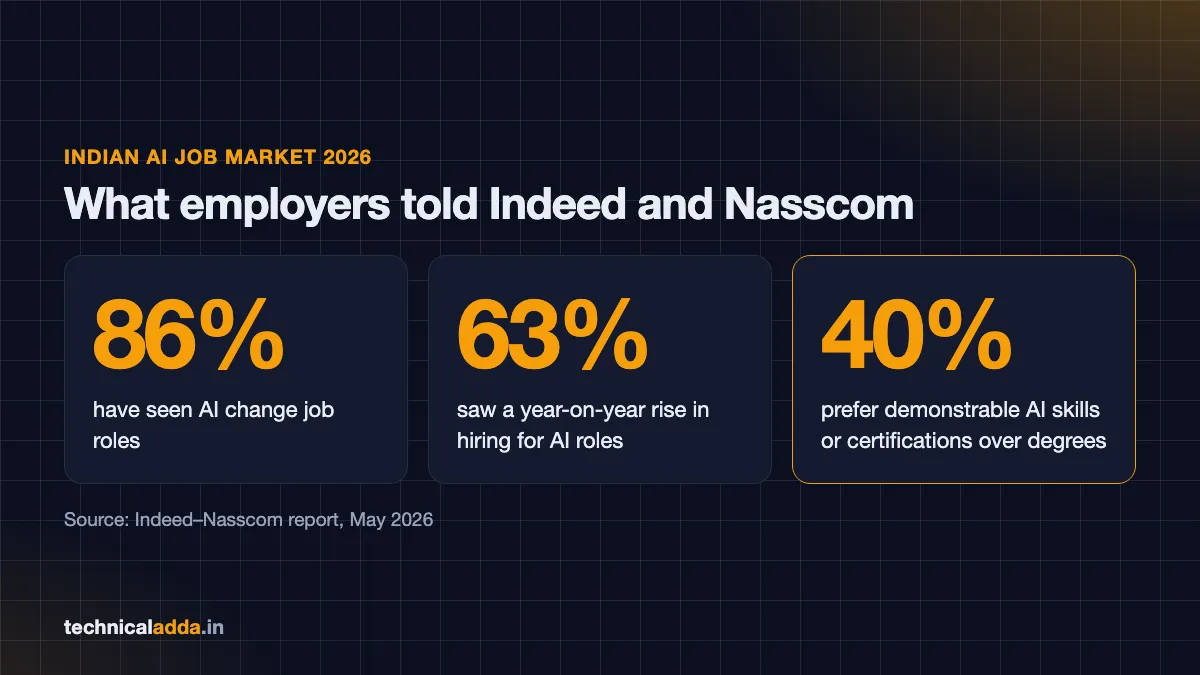
- An Indeed and Nasscom report released in May 2026 found that 86% of employers have seen AI change job roles, and 63% saw a year-on-year rise in hiring for AI-related roles, led by banking, financial services and telecom (coverage by CIO&Leader (opens in new tab)).
- The same report said 40% of employers prefer demonstrable AI skills or certifications over degrees, and another 32% weigh skills, certifications and degrees equally.
- The top skills employers listed were cloud and infrastructure integration, generative AI and LLMs (including prompt engineering), MLOps and deployment, and data analytics and visualisation.
- A Nasscom–Deloitte report (August 2024) projected that India's AI talent demand would grow from 600,000–650,000 to more than 1.25 million during 2022–27 (Deloitte press release (opens in new tab)).
The message is simple: employers want people who can use and apply AI, not just talk about it. Skills you can show beat certificates you cannot explain.
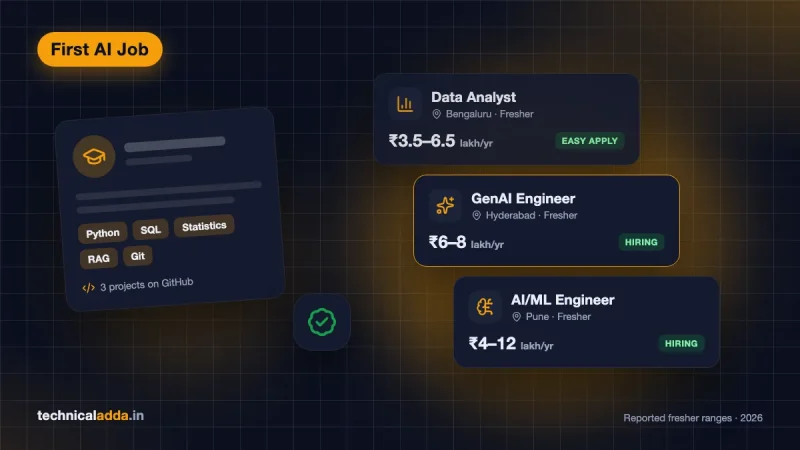
For specific roles and salaries, read our guide on AI jobs for freshers in India. If you are worried about automation, note that the same report found 35% of employers saw roles significantly redefined, so updating your skills matters more than ever.
AI skills to learn in 2026: the top 10
We have grouped these from "everyone should learn" to "advanced technical".
Level 1: Skills for everyone
1. AI literacy and prompt engineering
What it is: understanding what AI models can and cannot do, and writing clear instructions (prompts) to get useful output. It includes checking AI answers for errors, known as "hallucinations".
Why it matters: it is the base for every other AI skill, and Indeed–Nasscom lists generative AI and prompt engineering among the top skills employers want.
Learn it free: the Government of India's YUVA AI for ALL course on FutureSkills Prime (a short, self-paced course with a government certificate), and Anthropic Academy's free courses. See our upcoming guide to a free prompt engineering course in India.
2. Using AI tools in your daily work
What it is: using ChatGPT, Gemini, Claude, Copilot, NotebookLM and similar tools to write, research, analyse spreadsheets, make presentations and summarise documents faster.
Why it matters: this is where most non-tech jobs feel AI first. A marketing executive who can produce a campaign draft in an hour, or an accountant who automates Excel work, stands out quickly.
Learn it free: product help centres and free tiers of the tools themselves. Google's AI Essentials course is popular for beginners. As of October 2026, Coursera lists financial aid for it, and its monthly subscription starts with a 7-day free trial.
3. Responsible AI and data privacy
What it is: knowing about bias, deepfakes, copyright, and data protection, including India's Digital Personal Data Protection (DPDP) Act, 2023 and the DPDP Rules notified in November 2025, which set an 18-month phased timeline for most obligations. MeitY has consulted on shortening some deadlines, so check MeitY's website (opens in new tab) for the current compliance dates.
Why it matters: companies need people who can use AI without leaking customer data or breaking rules. This skill is valued in HR, legal, compliance, banking and healthcare.
Learn it free: the responsible and ethical AI module inside the YUVA AI for ALL course, and Microsoft Learn's free Introduction to Microsoft's Responsible AI Approach (opens in new tab) module.
Level 2: Core technical skills
4. Python programming
What it is: the main programming language of AI and data work.
Why it matters: almost every AI engineering, data science and ML job asks for it; Indeed–Nasscom lists Python among top skills for AI roles in tech.
Learn it free: Kaggle Learn's Python course, NPTEL's Python courses on SWAYAM, and Harvard's CS50 Python course (free to audit on edX).
5. Data analysis with SQL and visualisation
What it is: cleaning data, querying databases with SQL, and presenting insights in Excel, Power BI, Tableau or Python libraries.
Why it matters: AI is only as good as its data. Data analytics and visualisation appear in the top four skills employers prioritise, and data analyst roles are a common entry point for freshers.
Learn it free: Kaggle Learn (Pandas, SQL, Data Visualization), Microsoft Learn's Power BI paths, and Google Sheets/Excel practice on real datasets from data.gov.in.
6. Machine learning fundamentals
What it is: how models learn from data: regression, classification, evaluation, overfitting, and basic neural networks.
Why it matters: even if you mostly use pre-built AI models, understanding ML basics helps you judge results and talk to engineers.
Learn it free: Kaggle Learn's Intro to Machine Learning, fast.ai's Practical Deep Learning course, and NPTEL machine learning courses from IITs.
Level 3: Advanced and high-demand skills
7. Building LLM applications (APIs and RAG)
What it is: connecting large language models to apps using APIs, and using RAG (retrieval-augmented generation) so the model answers from company documents. Includes embeddings, vector databases and evaluation.
Why it matters: this is one of the most common AI engineering tasks in Indian IT services and startups right now.
Learn it free: Hugging Face's free LLM course, Anthropic Academy's API courses, Google AI Studio's free tier, and DeepLearning.AI's short courses, which its learning platform FAQ describes as free.
8. AI agents and MCP
What it is: building AI systems that take actions, such as calling tools, searching databases or filling forms, rather than just chatting. The Model Context Protocol (MCP) has become a common way to connect AI assistants to tools and data.
Why it matters: companies are moving from chatbots to agents that complete tasks. Engineers who can build and secure agents are in short supply.
Learn it free: Anthropic Academy's MCP and agent courses, plus official SDK documentation. Read our explainer on what an MCP server is to understand the basics first.
9. AI-assisted coding
What it is: using tools such as GitHub Copilot, Cursor or Claude Code to write, test and review code faster, while still understanding what the code does. The casual, prompt-first style of this is often called "vibe coding".
Why it matters: many software teams now expect developers to be productive with AI coding assistants. Freshers who can show clean, AI-assisted projects on GitHub have an edge.
Learn it free: free tiers of coding assistants, and our explainer on what vibe coding is.
10. MLOps and cloud deployment
What it is: taking models from a notebook to production: Docker, CI/CD, monitoring, cost control, and cloud platforms such as AWS, Azure and Google Cloud.
Why it matters: Indeed–Nasscom lists cloud and infrastructure integration as the number one skill employers want, with MLOps and deployment third. AWS and Azure certifications were among the most requested for tech roles.
Learn it free: free-tier learning paths on AWS Skill Builder, Microsoft Learn and Google Cloud Skills Boost. Paid certification exams are optional. If you prefer one subscription for many guided courses, Coursera Plus costs ₹2,099 a month or ₹13,999 a year in India (as of October 2026), with a 7-day free trial on the monthly plan.
Skills summary table
| # | Skill | Level | Time to basic proficiency* | Best for | Example proof |
|---|---|---|---|---|---|
| 1 | AI literacy and prompting | Everyone | 2–4 weeks | All roles | Prompt library, before/after work samples |
| 2 | AI tools at work | Everyone | 2–4 weeks | Non-tech and tech | Case study of time saved |
| 3 | Responsible AI and privacy | Everyone | 2–3 weeks | HR, legal, BFSI, managers | Policy draft or checklist |
| 4 | Python | Technical | 6–8 weeks | Tech, data | GitHub scripts |
| 5 | Data analysis and SQL | Technical | 6–8 weeks | Analysts, freshers | Dashboard on public data |
| 6 | ML fundamentals | Technical | 8–10 weeks | Data science, AI roles | Kaggle notebook |
| 7 | LLM apps and RAG | Advanced | 6–8 weeks | Developers | Chat-with-PDF app |
| 8 | AI agents and MCP | Advanced | 4–6 weeks | Developers | Agent that completes a real task |
| 9 | AI-assisted coding | Advanced | 2–4 weeks | Developers | Shipped project with tests |
| 10 | MLOps and cloud | Advanced | 8–12 weeks | AI/ML engineers | Deployed model with monitoring |
*Rough estimates for 1–2 hours of study per day; your pace will vary.
Skills for non-tech roles
You do not need to code to benefit from AI. Here is how skills 1–3 apply to common Indian careers:
- Marketing and content: AI for research, first drafts, SEO briefs, social media calendars and simple video. Learn to edit AI drafts so they sound human.
- Sales and customer support: AI for call summaries, CRM notes, email drafts and FAQ bots. Learn to check facts before sending.
- Finance and accounting: AI for Excel formulas, reconciliation help and report drafts. Learn to double-check every AI-generated formula.
- HR: AI for job descriptions, screening support and policy drafts, with a strong focus on bias and privacy.
- Teachers: AI for lesson plans, quizzes and differentiated worksheets in Hindi and regional languages.
- Government exam aspirants: AI for revision notes and quizzes from your own material, using tools like NotebookLM.
Regional language skills are a real advantage. India-focused AI tools increasingly support Indian languages, and people who can test and improve AI output in Hindi, Tamil, Bengali or Marathi are useful to companies serving Bharat users.
Best free resources to learn AI in India
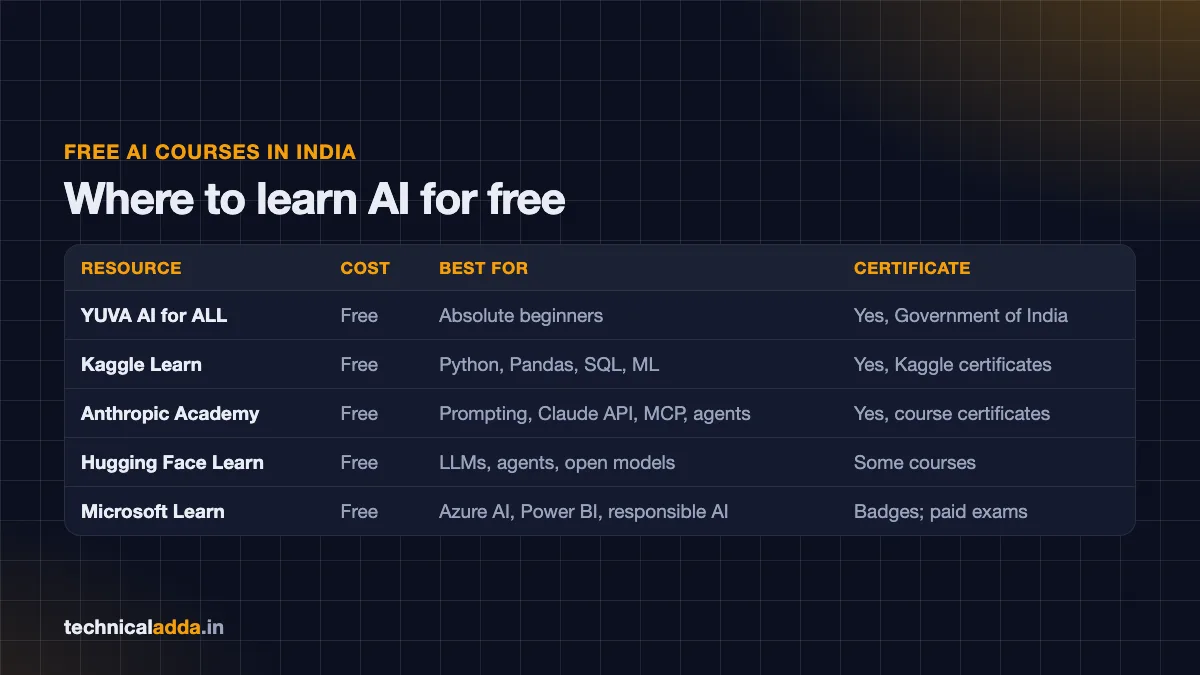
| Resource | Cost | Best for | Certificate | Link |
|---|---|---|---|---|
| YUVA AI for ALL (IndiaAI / MeitY) | Free | Absolute beginners | Yes, Government of India | FutureSkills Prime (opens in new tab) |
| SWAYAM / NPTEL | Free to learn; exam fee for certificate | Python, ML, data (IIT faculty) | Yes, after proctored exam (₹1,000 per course as of October 2026) | SWAYAM (opens in new tab) |
| Anthropic Academy | Free | Prompting, Claude API, MCP, agents | Yes, course certificates | anthropic.com/learn (opens in new tab) |
| Kaggle Learn | Free | Python, Pandas, SQL, ML | Yes, Kaggle certificates | kaggle.com/learn |
| fast.ai | Free | Practical deep learning | No | course.fast.ai |
| Hugging Face Learn | Free | LLMs, agents, open models | Some courses | huggingface.co/learn |
| Microsoft Learn | Free | Azure AI, Power BI, responsible AI | Badges; paid exams for certifications | learn.microsoft.com |
| Google AI Essentials (Coursera) | Paid subscription; financial aid and 7-day free trial available | Using AI at work | Yes | See below |
| DeepLearning.AI | Short courses free; paid Pro membership | GenAI, RAG, agents | Varies | See below |
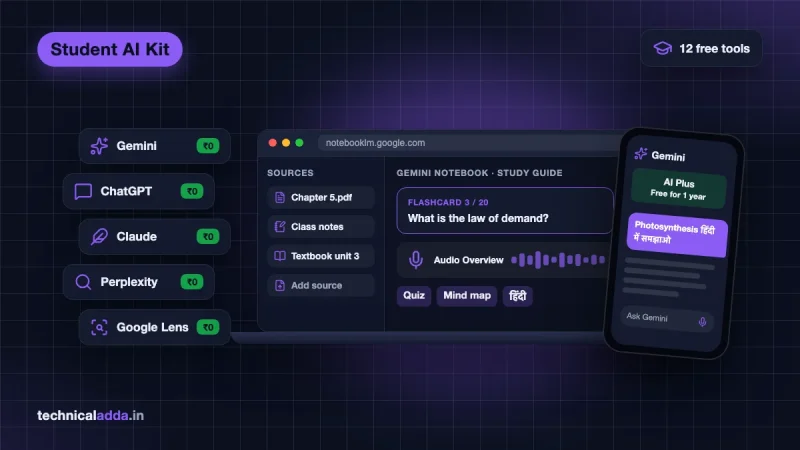
Students may also get free premium AI tools through student offers, which help with practice. Check the official student pages of each AI tool for current offers.
6-month AI learning roadmap
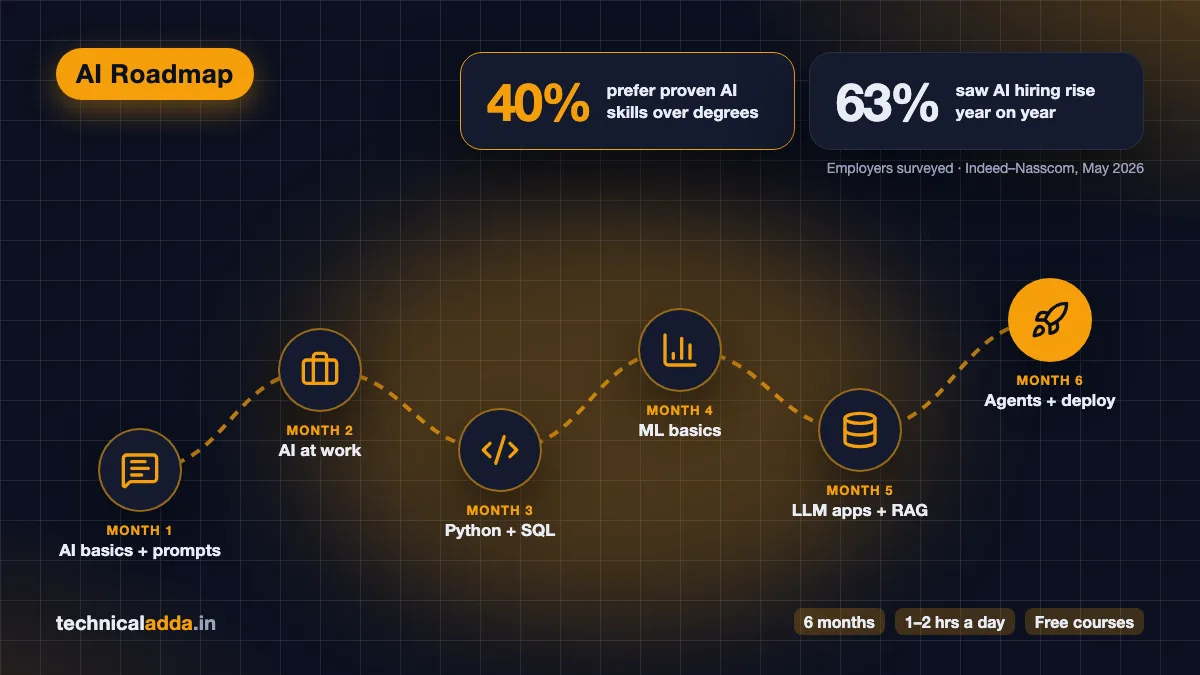
This roadmap assumes 1–2 hours per day. Non-tech learners can stop after Month 2 and go deeper into tools for their own field. Tech learners should complete all six months.
| Month | Focus | What to learn | Project to build |
|---|---|---|---|
| 1 | AI foundations | AI literacy, prompting, responsible use; complete YUVA AI for ALL | Personal prompt library for your job or studies |
| 2 | AI at work | ChatGPT/Gemini/Claude, NotebookLM, AI in Excel and Docs | Case study: one task done 2x faster with AI |
| 3 | Python + data | Python basics, Pandas, SQL | Analyse an Indian public dataset (data.gov.in) |
| 4 | ML basics | Regression, classification, evaluation | Kaggle notebook with a clear write-up |
| 5 | LLM apps | APIs, embeddings, RAG | "Chat with your college notes" or "company FAQ bot" |
| 6 | Agents + deployment | MCP, tool use, Docker, cloud free tier | Deploy an agent that completes one real task, with a demo video |
Tips to stick with it:
- Learn, then build in the same week. A course without a project fades fast.
- Post your progress on LinkedIn or GitHub every two weeks. It builds proof and confidence.
- Join a community such as a college AI club, local meetups, or online study groups.
- Review monthly. AI tools change fast; swap tools if better free ones appear.
How to prove your AI skills to recruiters
Since many employers now value demonstrable skills, proof matters more than a long list of certificates.
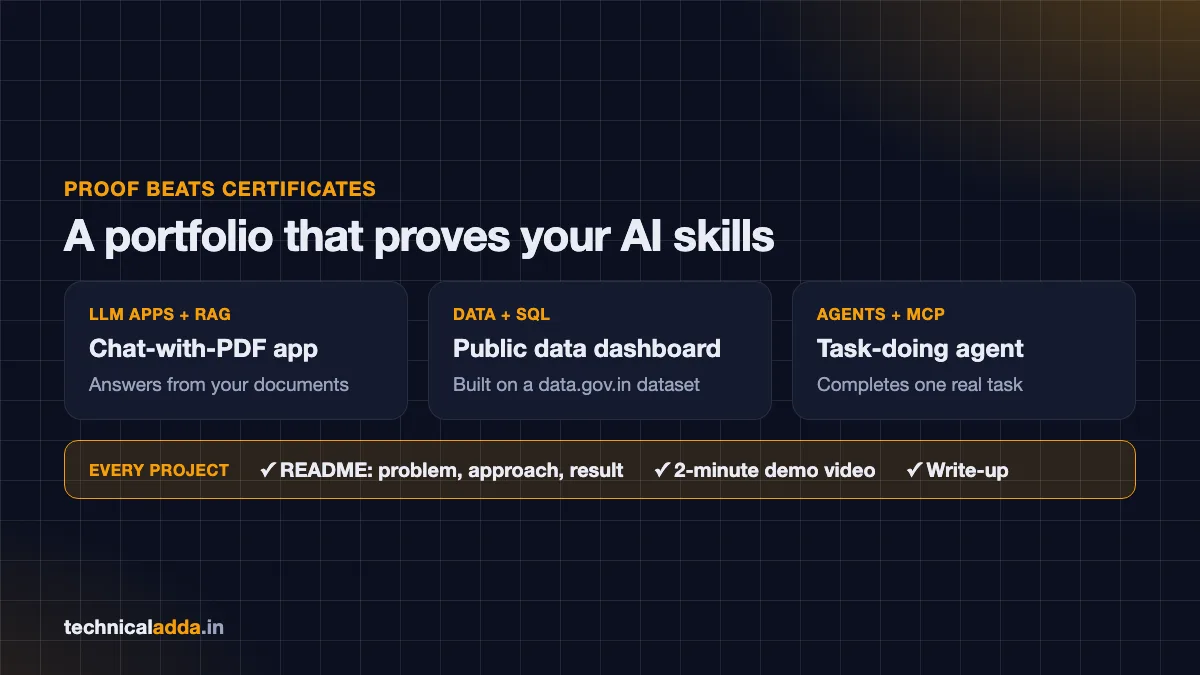
- GitHub portfolio: 3–5 clean projects with a README that explains the problem, approach and result.
- Short demo videos: a 2-minute screen recording of your project working.
- Write-ups: a LinkedIn post or blog explaining what you built and what went wrong.
- Kaggle profile: notebooks and competition attempts show data skills.
- Certificates: list a few relevant ones (government, cloud, or well-known platforms), not twenty.
- Resume bullets with numbers: "Built a RAG chatbot over 200 policy PDFs that answers staff questions with citations." Our guide on ChatGPT prompts for resume helps you write these.
Common mistakes to avoid
- Collecting certificates without projects. Recruiters ask "show me", not "tell me".
- Jumping to advanced topics too early. Agents and RAG are hard without Python and data basics.
- Paying for expensive bootcamps before trying free options. Most fundamentals are free.
- Ignoring communication skills. The Indeed–Nasscom report lists communication among top skills for software and internship roles.
- Trusting AI output blindly. Every project should show how you checked and evaluated results.
- Chasing every new tool. Learn concepts that last (data, prompting, evaluation, deployment); tools change every few months.
Key takeaways
- The best AI skills to learn in 2026 range from AI literacy and prompting to RAG, agents and MLOps.
- Indian employers increasingly value demonstrable skills; 40% prefer them over degrees, per the Indeed–Nasscom report.
- Non-tech professionals can gain a strong edge with skills 1–3 alone.
- Strong free resources exist: YUVA AI for ALL, SWAYAM/NPTEL, Anthropic Academy, Kaggle Learn, fast.ai and Hugging Face.
- Follow a 6-month roadmap and build one project every month.
- Prove skills with GitHub projects, demos and measurable resume bullets.
Conclusion
The AI skills to learn in 2026 are not a mystery: start with AI literacy and tools, add Python and data, then move to LLM apps, agents and deployment if you want a technical role. Use free resources first, build one project a month, and show your work publicly.
Ready to turn skills into a job? Read our guide on AI jobs for freshers in India next, or explore more career guides in AI Careers.
FAQ
Frequently Asked Questions
Which AI skill is most in demand in 2026?
According to the Indeed–Nasscom report released in May 2026, the top skills Indian employers prioritise are cloud and infrastructure integration, generative AI and LLMs including prompt engineering, MLOps and deployment, and data analytics. For most beginners, generative AI and prompting is the quickest starting point, while cloud and MLOps suit those aiming for engineering roles.
Can I learn AI without coding?
Yes. Many valuable AI skills need no coding: AI literacy, prompt engineering, using AI tools at work, and responsible AI. These help in marketing, HR, finance, sales and teaching. If you later want AI engineering or data science roles, you will need Python and data skills, but you can start without them.
Are there free AI courses with certificates in India?
Yes. The Government of India's YUVA AI for ALL course on FutureSkills Prime is free and offers a government certificate. Anthropic Academy and Kaggle Learn offer free courses with certificates. SWAYAM and NPTEL courses are free to study, though the proctored certificate exam usually has a fee. Check each platform for current terms.
How long does it take to learn AI skills?
Basic AI literacy and prompting take two to four weeks with an hour a day. Python and data analysis take about two months each for a working level. Becoming job-ready for an AI engineering role usually takes six months to a year of consistent study and project building, depending on your starting point.
Is prompt engineering still a useful skill in 2026?
Yes, but as a core skill rather than a standalone job. Most employers want people who can prompt well as part of a role like developer, analyst or marketer. Indeed–Nasscom lists generative AI and prompt engineering among top skills. Pair prompting with domain knowledge and evaluation skills to make it valuable.
What AI skills should a fresher learn first?
A fresher should first learn AI literacy and prompting, then Python and data analysis with SQL. These open doors to analyst, support and junior developer roles. Next, add machine learning basics and one LLM project, such as a chat-with-documents app. Build a GitHub portfolio as you learn rather than only collecting certificates.
Do I need a degree to get an AI job in India?
Not always. The Indeed–Nasscom report found that 40% of employers prefer demonstrable AI skills or certifications over degrees, and 32% weigh them equally. Many large companies still use degrees as a filter for some roles. A strong portfolio, relevant certifications and internships can help you compete even without a specialised AI degree.
Which programming language is best for AI?
Python is the best language to start with for AI. It has the largest set of AI and data libraries, most tutorials use it, and it appears in most AI job descriptions. JavaScript or TypeScript is useful if you build AI web apps, and SQL is essential for working with data.
Is it worth paying for an AI course?
Only after you have tried free options. Free resources such as YUVA AI for ALL, SWAYAM, Kaggle Learn, fast.ai and Anthropic Academy cover the fundamentals well. A paid course can be worth it if it offers mentorship, structured projects, placement support with a verifiable track record, or an industry-recognised certification you need.
Will AI skills help in government jobs?
AI skills can help in many government and public-sector roles where digital tools are being adopted, and they help aspirants study more efficiently. Recruitment exams still focus on their official syllabus, so treat AI skills as an addition, not a replacement, for exam preparation. Check each recruitment notice for required qualifications.
Where to buy
-
Visit official site (opens in new tab)
Google AI Essentials
-
Visit official site (opens in new tab)
DeepLearning.AI courses
-
Visit official site (opens in new tab)
Coursera Plus