AI Jobs for Freshers in India (2026): Roles, Skills, Salaries and How to Get Hired
AI Careers 13 min read By Xavio Thomas
In this articleTable of contents13
Last updated: 10 October 2026
Every placement season, students ask the same question: are there really AI jobs for freshers in India, or do companies only hire people with 3–5 years of experience? The honest answer is that entry-level AI roles exist, but they look different from the "AI scientist" jobs you see in headlines. Most freshers enter through data, software and GenAI application roles first.
This guide explains which roles hire freshers, the skills you need, realistic salary ranges with sources, where to apply, the portfolio projects that impress recruiters, and how to crack the interview.
Quick answer: Freshers in India usually enter AI through roles like data analyst, junior ML engineer, GenAI/LLM application developer, data engineer and AI data annotation or evaluation roles. Core skills are Python, SQL, statistics, ML basics and building LLM apps. Indeed India data shows average pay of about ₹6.2 lakh for data analysts and ₹11.2 lakh for ML engineers, with freshers typically starting lower.
Is there real demand for AI jobs for freshers in India?
Yes, demand is real and growing, but competition is also high.
- A Bain & Company report covered in March 2025 projected that AI job openings in India could cross 2.3 million by 2027, while the AI talent pool may reach only about 1.2 million (People Matters coverage (opens in new tab)).
- A Nasscom–Indeed report titled India's AI Talent Inflection Point released in May 2026, found that 86% of employers have seen AI change job roles, and nearly all organisations expect their 2026 workforce strategy to centre on AI-related or AI-supported roles, with 40% expecting a major rejig (CXOToday coverage (opens in new tab)).
What this means for freshers
- Pure research jobs (like "AI Research Scientist") mostly go to people with a master's or PhD.
- Applied roles (building apps with AI, working with data, testing AI outputs) are where freshers actually get hired.
- Skills beat degrees more often in AI hiring than in many other fields. A strong GitHub and real projects can beat a higher CGPA.
- Every tech job is becoming an AI job. Software, testing, support and analytics roles now expect you to use AI tools well.
Worried about AI taking developer jobs instead? Read our upcoming analysis on whether AI will replace software engineers.
Top AI roles that hire freshers
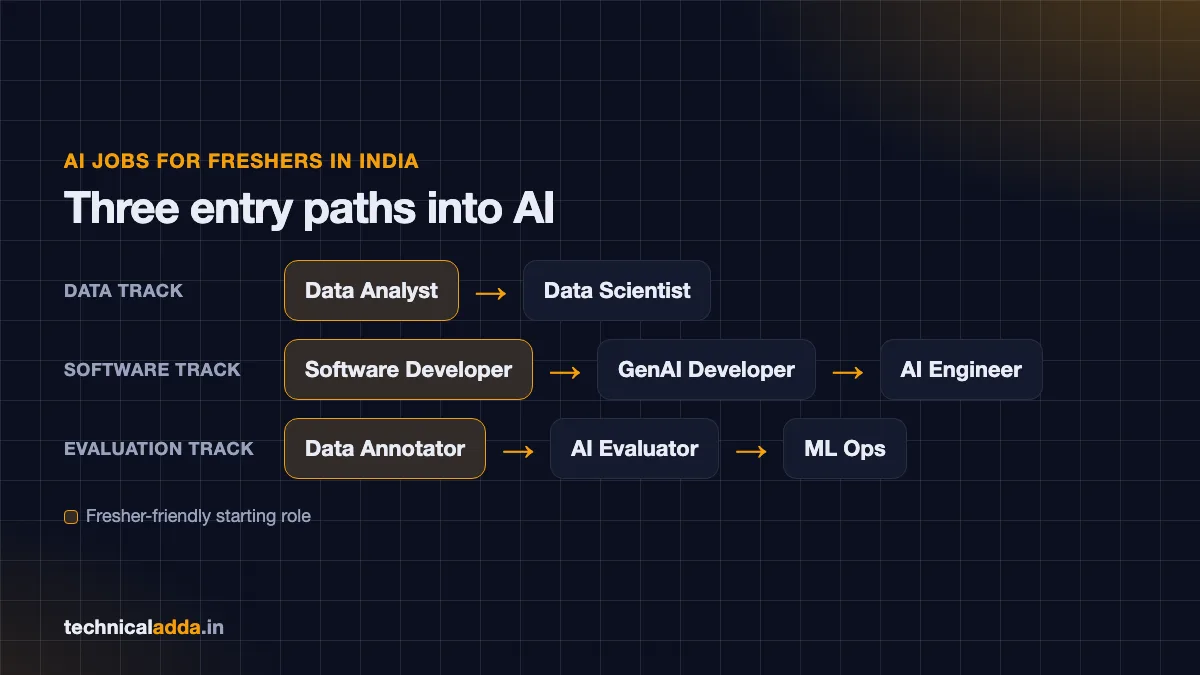
Here are the most realistic entry points in 2026.
1. Data Analyst
The most common door into AI. You clean data, write SQL, build dashboards in Power BI or Tableau, and increasingly use AI tools to speed up analysis. Many data analysts move into data science within 2–3 years.
Best for: BCom, BSc, BBA, BTech graduates who like numbers and business.
2. Junior Machine Learning (ML) Engineer
You help train, test and deploy machine learning models. Freshers usually work on data pipelines, model evaluation and small improvements, not on inventing new algorithms.
Best for: BTech/BE (CS, IT, ECE) or MSc graduates with strong Python and maths.
3. GenAI / LLM Application Developer (often called "AI Engineer")
The fastest-growing fresher-friendly role. You build products using large language models: chatbots, document Q&A (RAG), AI agents and integrations. You work with APIs from OpenAI, Anthropic and Google, plus tools like LangChain, vector databases and MCP servers.
Best for: Software developers who want to move into AI quickly.
4. Data Engineer
You build the pipelines that move and prepare data for AI models. Every AI team needs data engineers, and demand is steady.
Best for: Freshers good at SQL, Python and cloud basics (AWS, Azure, GCP).
5. Junior Data Scientist
You analyse data, build predictive models and explain results to business teams. True fresher openings are fewer than for analysts, but they exist at analytics firms and GCCs (global capability centres).
6. AI Data Annotation, Evaluation and RLHF roles
Companies need people to label data, rate AI answers, write test prompts and check outputs in Indian languages. These roles are easier to enter, and Hindi, Tamil, Telugu, Bengali or Marathi skills are a real advantage. Pay varies widely and many roles are contract-based.
7. AI-Enabled Software Developer / QA Engineer
Not titled "AI", but these roles now expect you to use AI coding tools daily and sometimes test AI features. Knowing tools like Cursor or GitHub Copilot (see our Cursor vs GitHub Copilot comparison) is a plus.
8. Prompt Engineer / AI Content Specialist
Pure "prompt engineer" jobs are rarer than social media suggests. Prompting is usually part of a bigger role (content, marketing, support or development). Learn it as a skill, not as your only job title.
Quick comparison of fresher AI roles
| Role | Entry difficulty | Key skills | Typical background |
|---|---|---|---|
| Data Analyst | Easy–Medium | SQL, Excel, Power BI, Python basics | Any graduate |
| Junior ML Engineer | Hard | Python, ML, maths, deployment | BTech/MSc |
| GenAI/LLM Developer | Medium | Python/JS, LLM APIs, RAG, agents | BTech/BCA/MCA |
| Data Engineer | Medium | SQL, Python, cloud, ETL | BTech/BCA/MCA |
| Junior Data Scientist | Hard | Stats, ML, Python, communication | BTech/MSc/MA Economics |
| AI Data Annotation/Evaluation | Easy | Attention to detail, language skills | Any graduate |
| AI-enabled Developer/QA | Medium | Coding + AI tools | BTech/BCA/MCA |
Skills you need (and in what order)
Don't try to learn everything at once. Follow this order.
Foundation skills (months 1–2)
- Python – Variables, loops, functions, lists, dictionaries, file handling.
- SQL – SELECT, JOIN, GROUP BY, window functions.
- Statistics – Mean, median, standard deviation, probability, hypothesis testing basics.
- Excel/Google Sheets – Still used in almost every analytics job.
Core AI/ML skills (months 3–4)
- Pandas and NumPy for data handling.
- Machine learning basics with scikit-learn: regression, classification, train/test split, overfitting.
- Evaluation metrics: accuracy, precision, recall, F1, RMSE.
- Git and GitHub for showing your work.
Modern GenAI skills (months 5–6)
- LLM APIs – Calling models from Python, handling tokens and costs.
- RAG (Retrieval-Augmented Generation) – Embeddings, vector databases, chunking.
- AI agents and tool calling – Including MCP.
- Prompting – Clear instructions, examples and output formats.
- Basic deployment – Streamlit, FastAPI, Docker basics, free cloud tiers.
Soft skills recruiters notice
- Explaining a technical idea in simple words
- Writing clean README files
- Asking good questions in interviews
- Honest communication about what you know and don't know
For a deeper skill list, read our guide on AI skills to learn in 2026.
AI fresher salary ranges in India (with sources)
Salaries vary a lot by city, company type and skills. A fresher at a large IT services company usually earns much less than one at a product company or a well-funded startup.
Average salaries by role (all experience levels)
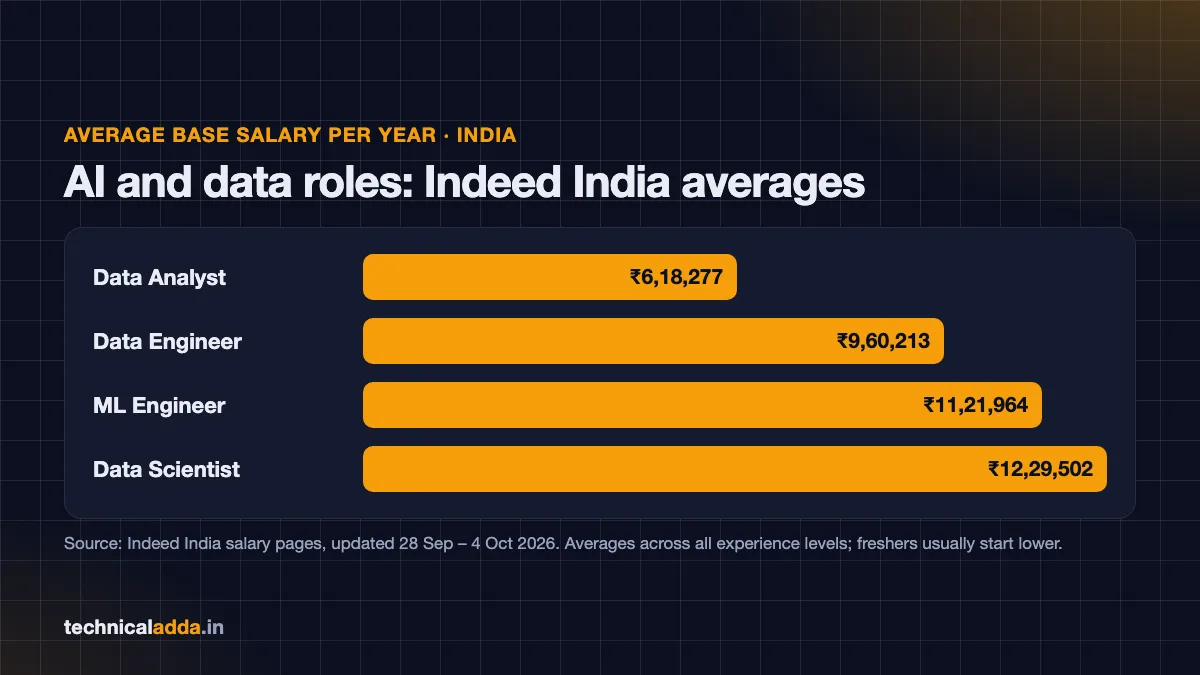
These figures come from Indeed India's salary pages, which are based on job postings over the past 36 months. They are averages across experience levels, not fresher-only figures.
| Role | Average base salary (per year) | Typical range on Indeed | Source (last updated) |
|---|---|---|---|
| Data Analyst | ₹6,18,277 | Not shown | Indeed India (opens in new tab) (4 Oct 2026, 575 salaries) |
| Data Engineer | ₹9,60,213 | ₹4.98 lakh – ₹18.5 lakh | Indeed India (2 Oct 2026, ~1,000 salaries) |
| Machine Learning Engineer | ₹11,21,964 | ₹6.22 lakh – ₹20.2 lakh | Indeed India (opens in new tab) (28 Sep 2026, 52 salaries) |
| Data Scientist | ₹12,29,502 | ₹7.15 lakh – ₹21.2 lakh | Indeed India (opens in new tab) (1 Oct 2026, 327 salaries) |
What freshers usually get
Fresher-specific numbers are less reliable because few platforms publish them openly. Based on multiple 2026 career reports that cite AmbitionBox, Glassdoor and Indeed, commonly reported fresher ranges are:
| Role | Commonly reported fresher range (per year) | Notes |
|---|---|---|
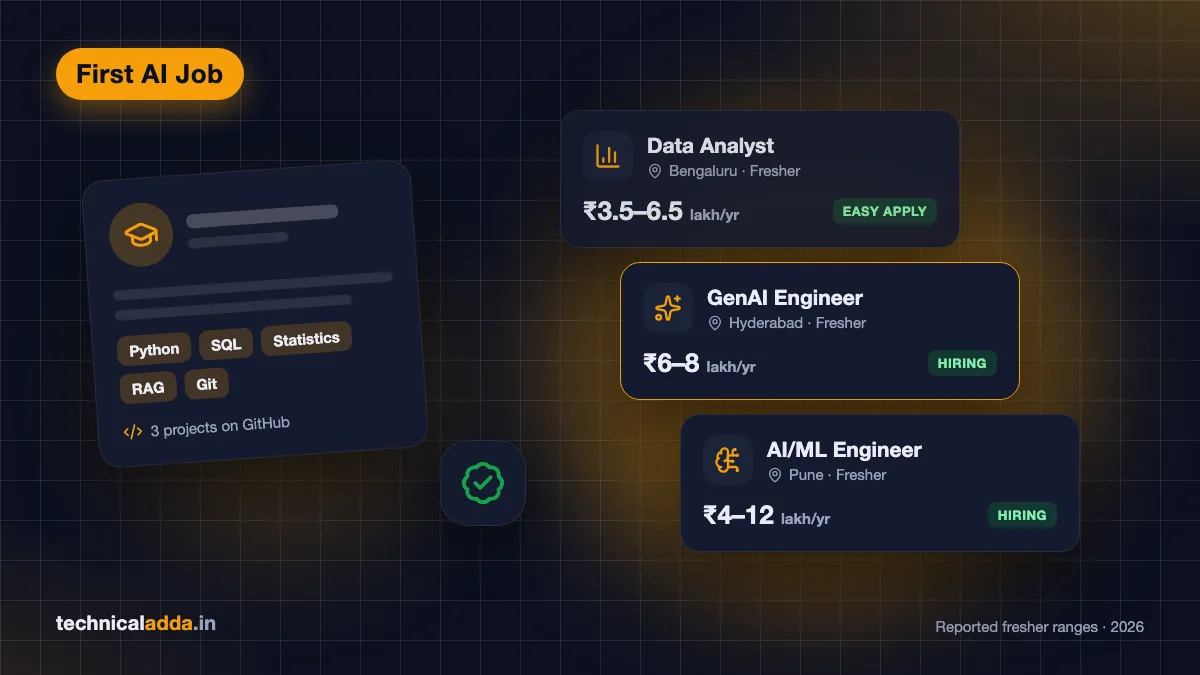
| Data Analyst | ₹3.5 – 6.5 lakh | Higher with an SQL + Power BI + Python portfolio |
| AI/ML Engineer | ₹4 – 12 lakh | Product firms and GCCs usually pay more than IT services |
| GenAI/AI Engineer | ₹6 – 8 lakh typical, up to ~₹15 lakh in specialised roles | Strong GenAI projects can push offers higher |
| AI Data Annotation/Evaluation | Varies widely, often contract | Depends on language, task type and employer; check current listings |
Important: Treat these as rough guides, not promises. Always check the latest figures on AmbitionBox, Glassdoor and Naukri for the specific company and city before negotiating.
Factors that raise your fresher salary
- Company type: Product companies, GCCs and funded startups usually pay more than service companies.
- City: Bengaluru, Hyderabad, Pune, Mumbai and Delhi NCR pay more than smaller cities.
- Projects: Deployed, working projects matter more than certificates.
- Internships: A 3–6 month AI or data internship can significantly improve your first offer.
- College tier: Still matters in campus hiring, but less in off-campus and startup hiring.
Where to apply for AI jobs as a fresher
Job portals
- Naukri.com – Biggest volume of Indian jobs; set alerts for "data analyst fresher", "ML engineer fresher", "GenAI developer".
- LinkedIn Jobs – Best for startups and GCCs; recruiters actively search profiles here.
- Instahyre and Cutshort – Good for tech startups.
- Wellfound – Startup jobs, including remote roles.
- Internshala – Internships that often convert to full-time offers.
- Indeed India – Wide coverage, useful for salary research too.
Other routes freshers ignore
- Company career pages – Many GCCs and product companies post jobs on their own sites first.
- Hackathons and competitions – Kaggle competitions, Smart India Hackathon and contests on Unstop get you noticed. Check sih.gov.in for the current Smart India Hackathon schedule.
- Open-source contributions – Fixing bugs in AI libraries shows real skill.
- Referrals – Message alumni on LinkedIn politely with a specific question, not "please refer me".
- Mass hiring tests – Service companies run national hiring tests (for example, TCS NQT, registered through the TCS NextStep portal). Check each company's careers portal for current drives and any AI or data tracks.
- Freelance AI work – Small paid projects build experience and portfolio.
Portfolio projects that get interviews
Recruiters see the same "Titanic survival" and "Iris flower" projects hundreds of times. Build projects that solve real Indian problems.
| Project idea | Skills shown | Level |
|---|---|---|
| Chatbot that answers questions from your college's PDF notices (RAG) | LLM APIs, embeddings, vector DB, Streamlit | Beginner–Intermediate |
| Hindi/Hinglish customer review sentiment analyser | NLP, data cleaning, model evaluation | Intermediate |
| Resume screener that matches resumes to job descriptions | Embeddings, ranking, prompt design | Intermediate |
| Crop disease detection from leaf photos | Computer vision, CNNs, mobile-friendly UI | Intermediate |
| Kirana store sales forecasting dashboard | Time-series, Pandas, Power BI | Beginner–Intermediate |
| Fraud transaction detector on a public dataset | Classification, class imbalance, metrics | Intermediate |
| Custom MCP server for a public API (weather, cricket scores, train status) | Tool calling, Python/TypeScript, agents | Intermediate |
| Local LLM assistant running on a laptop | Model deployment, quantisation basics | Intermediate |
For the last idea, see our guide on how to run an LLM locally on a laptop.
What makes a portfolio project stand out
- It's deployed. Share a live link, not just code.
- It has a clear README. Problem, approach, results, screenshots and how to run it.
- It shows numbers. "Accuracy improved from 78% to 86% after feature engineering."
- It's honest about limits. "Doesn't handle Tamil yet" shows maturity.
- It uses real data. Public datasets from data.gov.in or Kaggle, cleaned by you.
Using AI coding tools to build projects is fine and expected in 2026, but you must be able to explain every part in the interview.
Resume and LinkedIn tips for AI roles
- Keep it to one page. Freshers rarely need two.
- Projects above education if your projects are strong.
- Use action + result bullets: "Built a RAG chatbot over 200 college PDFs; answered 90% of test questions correctly."
- List tools honestly. Only add skills you can be questioned on.
- Add links: GitHub, deployed demos, LinkedIn, Kaggle profile.
- Match keywords from the job description so applicant tracking systems pick you up.
ChatGPT can help you polish wording. Use our ChatGPT prompts for resume writing, but always edit the output so it sounds like you.
Interview tips for AI fresher roles
Typical interview rounds
- Online assessment – Python, SQL, aptitude and basic ML MCQs.
- Technical round 1 – Coding problems and SQL queries.
- Technical round 2 – ML/AI concepts and deep-dive on your projects.
- Take-home assignment (common at startups) – Build a small model or AI feature in 2–5 days.
- HR/managerial round – Communication, attitude, salary discussion.
Questions you should be ready for
- What is overfitting and how do you prevent it?
- Explain precision vs recall with a real example.
- What is the difference between supervised and unsupervised learning?
- How does a large language model generate text? What are tokens?
- What is RAG, and why do we use it instead of fine-tuning?
- What is a hallucination, and how do you reduce it?
- Write a SQL query to find the second-highest salary.
- Walk me through your best project. What would you improve?
Tips that make a real difference
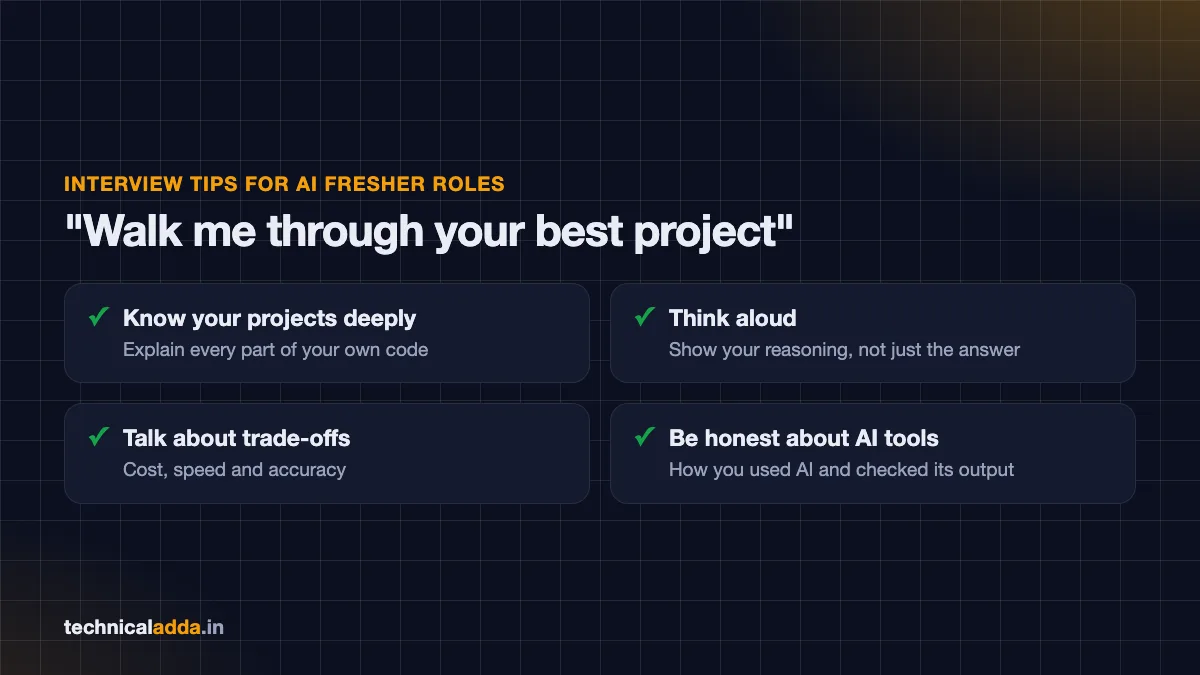
- Know your projects deeply. Most rejections happen when candidates can't explain their own code.
- Think aloud. Interviewers care about your reasoning, not just the final answer.
- Say "I don't know, but here's how I'd find out" instead of guessing.
- Talk about trade-offs. Cost, speed and accuracy matter in real AI products.
- Be honest about AI tool use. Say how you used AI and how you checked its output.
- Prepare questions to ask. "What does the first 90 days look like in this role?"
- Practise mock interviews with friends or AI tools, then with real people.
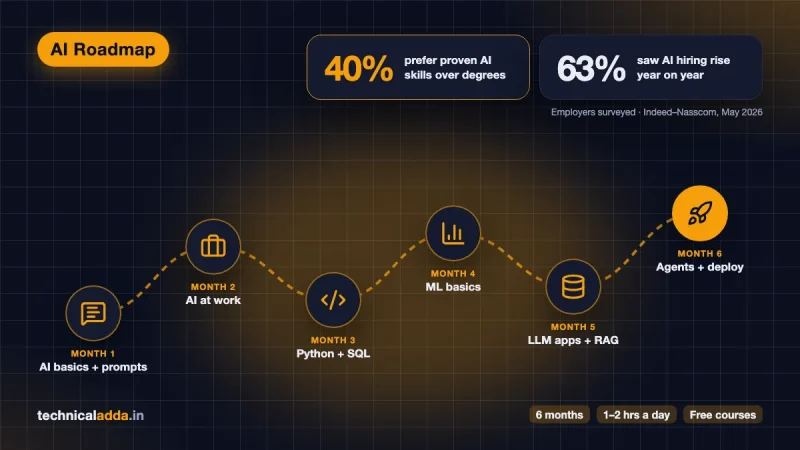
A 6-month plan to get your first AI job
| Month | Focus | Output by end of month |
|---|---|---|
| 1 | Python + SQL basics | 50 solved problems, 1 SQL mini-project |
| 2 | Statistics + Pandas + Excel | Data analysis project with a dashboard |
| 3 | Machine learning basics | 1 ML project with clear evaluation |
| 4 | GenAI: LLM APIs + RAG | Deployed document Q&A chatbot |
| 5 | Agents, MCP, deployment | Small agent or MCP server project, LinkedIn posts about your learning |
| 6 | Job hunt + interview prep | 50+ targeted applications, 10 mock interviews |
Spend at least 1–2 hours daily and post your progress on LinkedIn every week. Consistency matters more than speed.
Beware of fake AI job offers
Fake "AI jobs" and "work from home AI training" scams target freshers. Watch for these red flags:
- They ask you to pay a fee for training, registration, laptop or "security deposit".
- The offer comes on WhatsApp or Telegram without any interview.
- Salary is too high for a fresher with no experience.
- The email comes from a Gmail or Yahoo ID instead of the company domain.
- They ask for OTP, bank details or UPI PIN.
Genuine companies never ask freshers to pay for a job. If you lose money to a job scam, call the national cybercrime helpline 1930 or report it at cybercrime.gov.in as soon as possible.
Key takeaways
- AI jobs for freshers in India are real, but most entry points are applied roles: data analyst, GenAI developer, junior ML engineer, data engineer and AI evaluation.
- Learn in order: Python and SQL, then statistics and ML, then LLM apps, RAG and agents.
- Indeed India averages range from about ₹6.2 lakh (data analyst) to ₹12.3 lakh (data scientist) across all experience levels; freshers usually start lower.
- Deployed, India-focused portfolio projects beat certificates.
- Never pay for a job offer; report scams to 1930 or cybercrime.gov.in.
Conclusion
AI jobs for freshers in India are not a myth, but they reward skills and proof of work more than degrees. Start with Python and SQL, add machine learning and GenAI skills, build India-focused projects you can explain, and apply smartly through portals, referrals and hackathons. Within six months of steady effort, a first AI or data role is a realistic goal.
Your next step: plan your learning with our guide on AI skills to learn in 2026, and explore more career guides in our AI Careers section.
FAQ
Frequently Asked Questions
Can a fresher get an AI job in India?
Yes, freshers can get AI jobs in India, mainly in applied roles like data analyst, GenAI application developer, junior ML engineer, data engineer and AI data evaluation. Research roles usually need a master's or PhD. A strong portfolio of deployed projects, good Python and SQL skills, and an internship greatly improve a fresher's chances of getting hired.
What is the salary of an AI engineer fresher in India?
AI engineer fresher salaries in India commonly range from about ₹4 lakh to ₹12 lakh per year, depending on company, city and skills. IT services firms often pay ₹4–8 lakh, while product companies and GCCs pay more. Indeed India shows an average of about ₹11.2 lakh for ML engineers across all experience levels, so freshers typically earn below that.
Which AI job is best for freshers?
For most freshers, data analyst and GenAI application developer are the best starting AI jobs. Data analyst roles have the most openings and accept graduates from many streams. GenAI developer roles are growing fastest and suit those with coding skills. The best choice depends on whether you enjoy business analysis with data or building software products with AI.
Do I need a degree in AI to get an AI job?
No, you don't need a specific AI degree to get an AI job in India. Many employers hire BTech, BCA, MCA, BSc and even commerce graduates who can show real skills. Projects, internships, GitHub work and interview performance often matter more than the degree name. However, research-focused roles usually prefer master's or PhD holders.
Is coding required for AI jobs?
Coding is required for most AI jobs, especially ML engineer, GenAI developer, data engineer and data scientist roles, where Python is the main language. Some entry-level roles, like AI data annotation, evaluation or prompt-based content work, need little or no coding. Even so, basic Python and SQL make you far more employable and open better-paying paths.
Which skills are most in demand for AI freshers in 2026?
The most in-demand skills for AI freshers in 2026 are Python, SQL, statistics, machine learning basics, and GenAI skills like using LLM APIs, building RAG systems and creating AI agents. Cloud basics, Git and deployment tools like Streamlit or FastAPI also help. Communication skills matter too, because you must explain AI results to non-technical people.
Where can freshers find AI jobs in India?
Freshers can find AI jobs on Naukri, LinkedIn, Indeed India, Instahyre, Cutshort, Wellfound and Internshala. Company career pages, especially of GCCs and product startups, are also good sources. Hackathons, Kaggle competitions, open-source contributions and alumni referrals often lead to interviews faster than mass applying through job portals alone.
Are prompt engineering jobs real for freshers?
Pure prompt engineering jobs exist but are rare for freshers in India. Most companies treat prompting as a skill inside bigger roles like GenAI developer, content specialist, support or marketing. It's better to learn prompt engineering alongside coding, data or domain skills rather than aiming only for a "prompt engineer" job title, which has limited openings.
How long does it take to get an AI job as a fresher?
With focused daily study of 1–2 hours, many freshers can become job-ready for entry-level AI or data roles in about 6 months. This includes learning Python, SQL, ML basics and GenAI, plus building 3–4 portfolio projects. The job search itself can take another 1–3 months, depending on the market, your projects and interview preparation.
How can I avoid fake AI job offers?
To avoid fake AI job offers, never pay any fee for training, registration or equipment, and verify that emails come from the official company domain. Be cautious of offers made on WhatsApp or Telegram without interviews, or with unrealistic salaries. Never share OTPs or UPI PINs. Report job scams to the cybercrime helpline 1930 or cybercrime.gov.in.