UPI Transaction Failed but Money Debited? Refund Timeline, Compensation and Complaint Steps (2026)
Digital India & UPI 14 min read By Sanjeev Pratap Singh
In this articleTable of contents12
Last updated: 10 October 2026
You scan a QR code, enter your UPI PIN, and the app shows “Failed” or keeps spinning on “Pending”. Then your bank SMS says the money has gone. The shopkeeper has not received it, and you are stuck in between. A UPI transaction failed but money debited is one of the most common digital payment problems in India, and the good news is that RBI rules protect you. This guide explains why it happens, the official refund timeline, the ₹100-per-day compensation rule, and a step-by-step complaint path from your UPI app all the way to the RBI Ombudsman, with ready-to-use complaint templates.
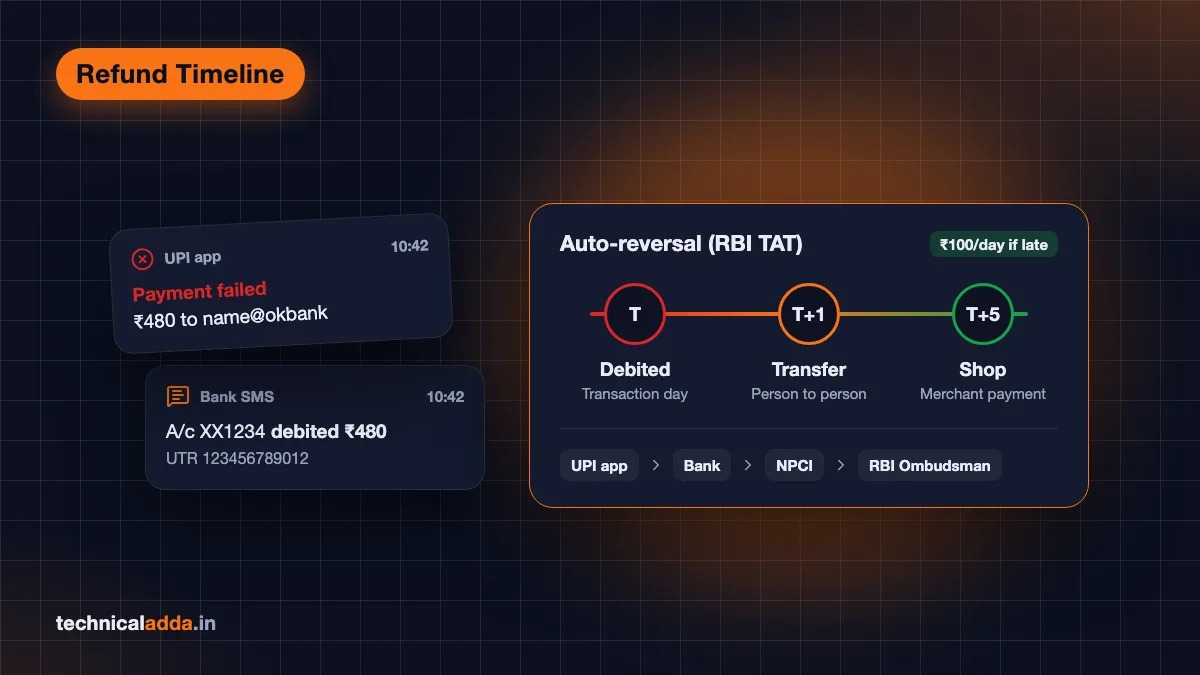
Quick answer: If a UPI payment fails but money is debited, it is usually auto-reversed. Under RBI’s harmonised TAT rules, a failed person-to-person transfer must be reversed by T+1 day and a failed merchant payment by T+5 days. If the bank misses this, it owes ₹100 per day of delay. If not refunded, complain in your UPI app, then your bank, NPCI and the RBI Ombudsman.
Why a UPI transaction fails but money gets debited
A UPI payment passes through several systems in a few seconds: your UPI app, your bank (remitter bank), NPCI’s UPI switch, the receiver’s bank (beneficiary bank) and, for shops, the merchant’s payment provider. Money leaves your account at one step and must be confirmed at another. If any link breaks in between, you get a “debited but not credited” situation.
Common reasons include:
- Server timeout at the beneficiary bank. Your bank debits you, but the receiver’s bank does not respond in time.
- Network drop on your phone. The payment went through on the bank side, but your app never received the final status.
- Bank downtime or maintenance. Banks often schedule maintenance late at night, and month-end salary days can see heavy load.
- Merchant-side confirmation failure. The bank processed the payment, but the shop’s terminal or payment gateway did not get the confirmation.
- Receiver account issues. The beneficiary account may be frozen, closed or have a credit limit.
- Technical decline after debit. Rare, but a reconciliation error can show the debit before the reversal is processed.
In most of these cases, the money is not lost. It is either sitting in a suspense or “in-transit” state, or it has reached the receiver and only the status message failed.
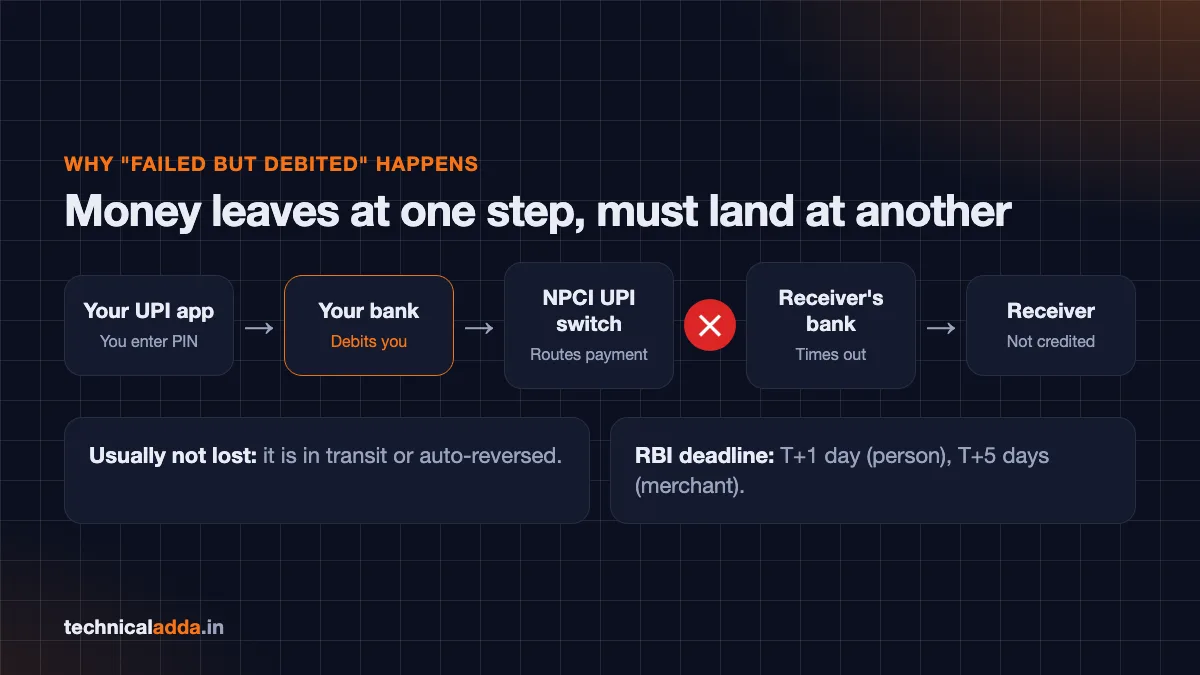
Failed vs pending vs successful: what your app status means
Before you panic or complain, read the status carefully. Each status needs a different action.
| App status | What it usually means | What you should do |
|---|---|---|
| Successful | Money reached the receiver | Ask the receiver to check their bank statement, not just their app |
| Pending / Processing | Final status not yet received from banks | Wait. Do not pay again. Check after a few hours |
| Failed + no debit | Payment never left your account | Nothing to do. You can pay again |
| Failed + debited | Debit happened, credit failed | Wait for auto-reversal within the RBI timeline |
| Successful in your app, receiver says not received | Receiver’s bank may have delayed credit | Share the UTR/RRN number with the receiver |
Important: Never make a second payment just because the first one shows “Pending”. If both go through, you will have to chase a refund from the receiver, and that is not covered by the auto-reversal rule.
UPI transaction failed money debited: the official refund timeline
The Reserve Bank of India fixed clear refund timelines in its circular “Harmonisation of Turn Around Time (TAT) and customer compensation for failed transactions using authorised Payment Systems” (DPSS.CO.PD No.629/02.01.014/2019-20, dated 20 September 2019). You can read the full text on the RBI website (opens in new tab).
For UPI, the circular lists two situations:
| Situation | RBI rule for auto-reversal | Compensation if late |
|---|---|---|
| Fund transfer (P2P): Account debited but beneficiary account not credited | Beneficiary bank must auto-reverse latest by T + 1 day | ₹100 per day of delay beyond T + 1 |
| Merchant payment (P2M): Account debited but merchant did not receive confirmation | Auto-reversal within T + 5 days | ₹100 per day of delay beyond T + 5 |
What T and R mean:
- T is the day of the transaction, counted as the calendar date.
- R is the day the reversal is concluded and the money is received back by the payer’s bank.
So if you paid a friend on 10 October and the money did not reach them, the reversal should complete by 11 October. If you paid a shop on 10 October and it failed at the merchant end, the reversal should complete by 15 October.
The circular also makes clear these are the outer limits. Banks are expected to resolve failures faster wherever possible, and in practice most UPI reversals happen within minutes or hours.
The timelines above come from RBI’s September 2019 TAT circular. RBI consolidated a large number of older circulars into Master Directions in late 2025, so before you quote a circular number in a complaint, check the current reference on rbi.org.in.
Compensation rules: the ₹100 per day rule
Here is what the RBI circular says about compensation, in plain language:
- It is automatic. Where compensation is due, the bank must credit it to your account on its own (suo moto), without waiting for you to complain or claim it.
- It is ₹100 per day of delay beyond the allowed TAT (T+1 for transfers, T+5 for merchant payments).
- It is paid by the bank at fault. For UPI transfers, the circular puts the reversal duty on the beneficiary bank.
- It applies to genuine failures, not wrong transfers. If you sent money to the wrong UPI ID and it was credited successfully, the TAT and compensation rules do not apply. That is a separate dispute.
If your bank counts the delay differently from you (for example, in working days rather than calendar days), ask it in writing which RBI rule it is applying.
Reality check: Automatic compensation is a rule, but it does not always show up on its own. If you see a delayed reversal and no ₹100/day credit, you can mention the RBI circular in your complaint and ask for it.
What to do in the first 24 hours
A calm, organised approach makes refunds faster. Do these in order.
- Do not pay again until the status is clear.
- Note the UTR / RRN number. This 12-digit number is the unique ID of the transaction. Find it in your UPI app’s transaction details or your bank SMS.
- Take screenshots of the app status, bank SMS and the merchant’s screen if possible.
- Check your bank statement (net banking or bank app), not just the UPI app. Sometimes the reversal reaches your bank before the app updates.
- Ask the receiver to check their bank statement using the UTR. If it is there, the payment actually worked.
- Wait for the TAT. For person-to-person transfers, give it until the end of T+1. For shops, up to T+5.
- Raise an in-app complaint if the TAT has passed or if the status is still pending after a few hours. Raising it early does no harm.
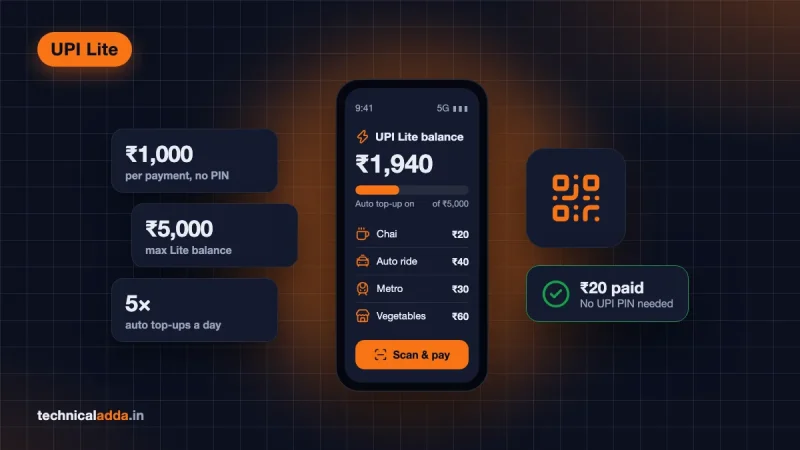
Note for UPI Lite users: UPI Lite payments are small and processed differently. If you use it, read our guide on how to use UPI Lite to understand how its balance and refunds work.
Step-by-step complaint path
If the money has not come back within the RBI timeline, follow this escalation ladder. NPCI’s dispute redressal mechanism (opens in new tab) describes the order: the UPI app first, then the PSP bank, then your own bank, then NPCI, and finally the RBI Ombudsman.
Step 1: Complain inside your UPI app
Every UPI app (Google Pay, PhonePe, Paytm, BHIM, bank apps) has a help section for each transaction.
- Open the app and go to Transaction History.
- Tap the failed or pending transaction.
- Look for Help, Raise a dispute, Report an issue or Get help.
- Choose the issue type, such as “Money debited but not received by recipient”.
- Submit and note the complaint/ticket number.
This in-app system is linked to NPCI’s online dispute resolution process, so the complaint reaches the banks involved. Exact menu names change with app updates, so if you do not see these labels, open the app’s Help or Support section and pick the transaction from there.
Step 2: Escalate to the PSP bank and your own bank
If the app does not resolve it, escalate to:
- The PSP bank behind your app (for example, the bank whose handle appears in your UPI ID, like @okaxis or @ybl), and
- Your own bank (the account that was debited).
How to do it:
- Use your bank’s customer care number printed on its official website or passbook.
- Use the grievance or complaint form on the bank’s website or app.
- Visit the branch with a written complaint and get an acknowledgement.
- Mention the UTR, date, amount, and your app complaint number.
Ask specifically for the reversal and for compensation as per the RBI TAT circular if the deadline has passed.
Step 3: Escalate to NPCI
If the banks do not resolve it, you can raise a complaint with NPCI through the complaint form on its UPI dispute redressal page. You will usually need:
- Transaction ID / UTR
- Bank name and VPA (UPI ID)
- Amount and date
- Email ID, mobile number
- Screenshot of the bank statement showing the debit
NPCI also offers a way to track complaint status online, and its UPI Help service (upihelp.npci.org.in) handles UPI transaction queries. Helpline numbers listed on third-party sites can be outdated, so take any phone number only from npci.org.in or your UPI app.
Step 4: RBI Ombudsman (RB-IOS 2026)
This is the final step if the bank’s response is unsatisfactory or late. From 1 July 2026, complaints are handled under the Reserve Bank – Integrated Ombudsman Scheme, 2026, which replaced the 2021 scheme. Complaints filed before 1 July 2026 continue under the 2021 scheme.
According to the RBI’s official FAQ on RB-IOS 2026 (opens in new tab):
- You must first complain to your bank and keep proof of that complaint.
- You can go to the Ombudsman if the bank does not reply within 30 days (or within the time set by RBI, NPCI or card network rules, whichever is higher), or if you are not satisfied with the reply.
- You must file with the Ombudsman within 90 days from the date that timeline expires or from the bank’s last communication, whichever is later.
- There is no fee. You do not need an agent or lawyer.
How to file:
| Channel | Details |
|---|---|
| Online | cms.rbi.org.in (Complaint Management System) |
| [email protected] | |
| Post | Centralised Receipt and Processing Centre, Reserve Bank of India, Central Vista, Sector 17, Chandigarh – 160017 |
| Helpline | Toll-free 14448 (IVRS 24×7; staff available 8 AM to 10 PM, Monday to Saturday except national holidays) |
The RBI Ombudsman can award compensation of up to ₹30 lakh for consequential loss and up to ₹3 lakh for loss of time, expenses and harassment, as per the FAQ. For a small failed UPI amount, the realistic outcome is the refund plus TAT compensation.
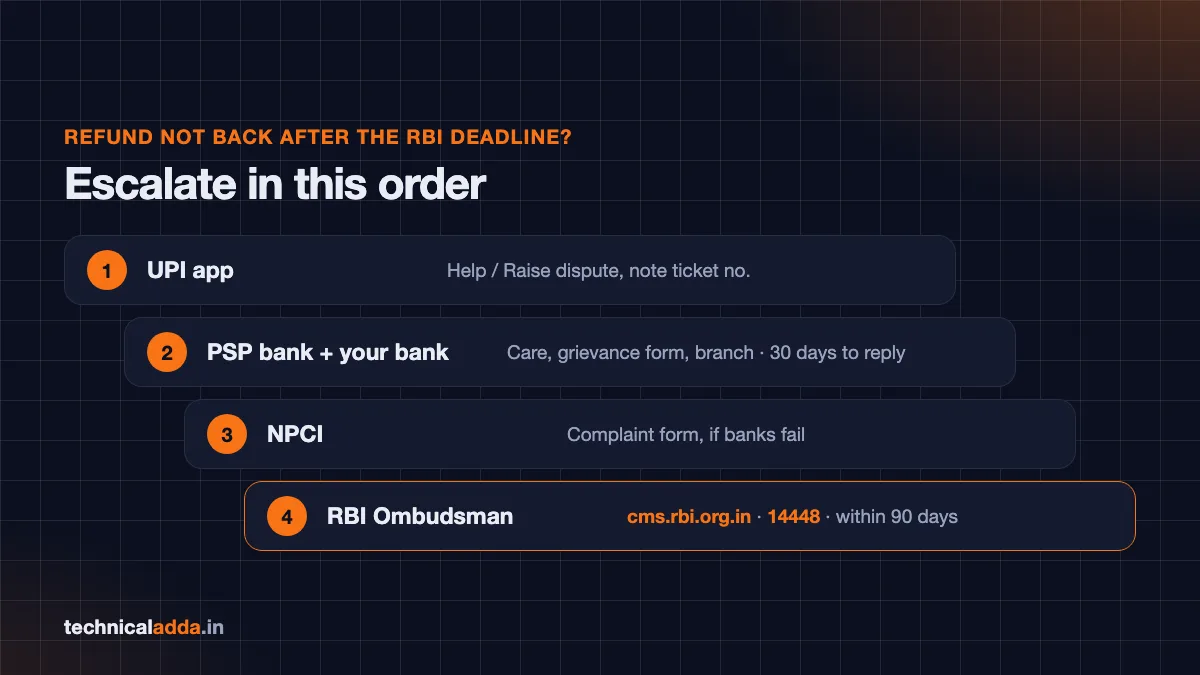
Escalation summary
| Level | Where | When to move to next level |
|---|---|---|
| 1 | UPI app (Help / Raise dispute) | No resolution after TAT and app response |
| 2 | PSP bank + your bank (customer care, grievance form, branch) | No reply in 30 days or unsatisfactory reply |
| 3 | NPCI complaint form | Banks fail to resolve |
| 4 | RBI Ombudsman (cms.rbi.org.in / 14448) | File within 90 days of bank’s deadline or last reply |
Complaint templates you can copy
Keep your complaint short, factual and polite. Replace the brackets.
Template 1: In-app or bank complaint
Subject: UPI transaction failed but amount debited – UTR [12-digit number]
Dear Sir/Madam,
On [date] at [time], I made a UPI payment of ₹[amount] from my account [last 4 digits] using [app name] to [receiver UPI ID / merchant name]. The app showed the transaction as [failed/pending], but the amount was debited from my account. The receiver has not received it.
UTR/RRN: [number]
In-app complaint number: [number, if any]As per RBI circular DPSS.CO.PD No.629/02.01.014/2019-20 dated 20 September 2019, failed UPI transactions must be reversed within T+1 day (T+5 for merchant payments), with compensation of ₹100 per day for delay. Kindly reverse the amount and credit any applicable compensation.
Screenshots of the app status and bank statement are attached.
Regards,
[Name], [Registered mobile number]
Template 2: Escalation to bank grievance officer
Subject: Escalation – unresolved failed UPI transaction, complaint no. [number]
Dear Grievance Redressal Officer,
I raised complaint no. [number] on [date] regarding a failed UPI transaction of ₹[amount] (UTR [number]) dated [date]. The amount has not been reversed, and the RBI TAT has expired. I request immediate reversal along with compensation as per the RBI TAT circular. If unresolved, I will approach the RBI Ombudsman under RB-IOS 2026.
Regards,
[Name]
Template 3: Short summary for RBI CMS portal
I made a UPI payment of ₹[amount] on [date] (UTR [number]) that failed but was debited from my [bank] account. I complained to the bank on [date] (complaint no. [number]). The bank has [not replied within 30 days / rejected the complaint / reversed without compensation]. I request reversal of ₹[amount] and compensation as per RBI’s TAT circular dated 20.09.2019.
Mistakes that delay your refund
- Paying twice. A second successful payment is not a “failed transaction” and must be recovered from the receiver.
- Not saving the UTR. Without it, banks take longer to trace the payment.
- Complaining only on social media. Public posts can help, but a formal complaint with a ticket number is what counts for escalation.
- Skipping the bank level. The RBI Ombudsman will not accept a complaint unless you first complained to the bank with proof.
- Waiting too long. The 90-day window for the Ombudsman starts after the bank’s deadline or last reply.
- Sharing OTP or UPI PIN with “refund agents”. No bank or NPCI official needs your PIN to send you money. Fake customer care numbers on search results and social media are a common scam. If someone sends you a “payment successful” image instead of real money, read our guide on how to identify a fake UPI payment screenshot.
Watch out for refund scams: If someone calls claiming to be from NPCI, RBI or your bank and asks you to install a screen-sharing app or approve a “collect request” to get your refund, hang up. Refunds come automatically to your account; you never need to enter a UPI PIN to receive money. Report such calls at cybercrime.gov.in (opens in new tab) or 1930, and see our step-by-step guide to report cyber fraud online in India.
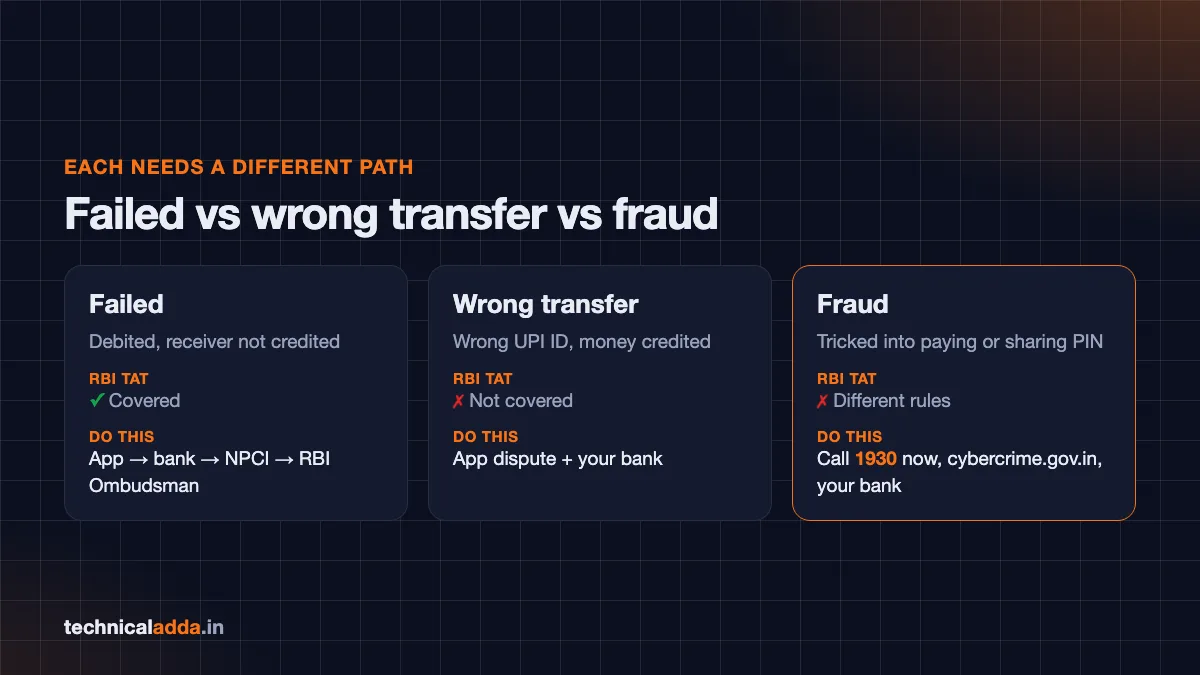
Failed UPI vs wrong UPI transfer vs fraud
These three are often confused, but each has a different path.
| Problem | Example | Covered by RBI TAT? | Where to go |
|---|---|---|---|
| Failed transaction | Money debited, receiver not credited | Yes | App → bank → NPCI → RBI Ombudsman |
| Wrong transfer | You typed the wrong UPI ID and it was credited | No | App dispute + your bank; recovery depends on the receiver |
| Fraud | You were tricked into paying or sharing PIN | No (different rules) | Call 1930 immediately, cybercrime.gov.in, and your bank |
For fraud, speed matters more than anything. Calling 1930 quickly helps police and banks try to freeze the money before it moves. Scammers also use fear tactics like fake police calls; learn the warning signs in our explainer on the digital arrest scam.
Key takeaways
- Most cases of UPI transaction failed but money debited are auto-reversed, often within hours.
- RBI’s TAT rule: failed P2P transfers must be reversed by T+1; failed merchant payments by T+5.
- Delay beyond the TAT attracts ₹100 per day compensation, which banks should credit automatically.
- Always save the UTR number and screenshots, and never pay twice for a pending transaction.
- Escalate in order: UPI app → PSP bank/your bank → NPCI → RBI Ombudsman (cms.rbi.org.in, 14448).
- Since 1 July 2026, Ombudsman complaints fall under RB-IOS 2026, with no fee and a 90-day filing window.
Conclusion
A UPI transaction failed but money debited situation is stressful, but it is rarely a permanent loss. RBI rules require auto-reversal within T+1 day for transfers and T+5 days for merchant payments, with ₹100 per day compensation for delays. Save your UTR, raise an in-app dispute, and escalate step by step to your bank, NPCI and the RBI Ombudsman if needed.
If a missed payment was for a loan or card bill, it is worth checking your credit report. Read our guide on how to check your CIBIL score for free, and explore more UPI and banking guides in our Digital India section.
FAQ
Frequently Asked Questions
How long does it take to get a refund for a failed UPI transaction?
Most failed UPI transactions are reversed automatically within a few hours. Under RBI’s harmonised TAT rules, a failed person-to-person transfer must be reversed by T+1 day, and a failed merchant payment by T+5 days, where T is the transaction date. If the bank misses this deadline, it must pay ₹100 per day of delay as compensation.
What should I do if my UPI payment failed but money was deducted?
First, do not pay again. Note the 12-digit UTR number from your app or bank SMS, take screenshots, and check your bank statement. Ask the receiver to check their account too. Wait for the RBI timeline (T+1 for transfers, T+5 for merchants), and raise a complaint in your UPI app’s help section if money is not reversed.
Do I get compensation if my UPI refund is delayed?
Yes. As per the RBI circular dated 20 September 2019, if a failed UPI transfer is not reversed within T+1 day, or a merchant payment within T+5 days, the bank must pay ₹100 per day of delay. The compensation should be credited automatically, without a claim. If it is not, mention the circular in your complaint.
What is a UTR number in UPI?
A UTR (Unique Transaction Reference) number, often shown as RRN in UPI apps, is a 12-digit number that identifies one specific UPI transaction. Banks and NPCI use it to trace where the money is. You can find it in your UPI app under transaction details or in your bank’s debit SMS. Always include it in complaints.
How do I complain to NPCI about a failed UPI transaction?
NPCI expects you to complain first in your UPI app, then with the PSP bank and your own bank. If they do not resolve it, you can use the complaint form on NPCI’s UPI dispute redressal page with the transaction ID, bank name, UPI ID, amount, date, and a bank statement screenshot. Keep your complaint numbers from earlier steps.
When can I complain to the RBI Ombudsman about UPI?
Under RB-IOS 2026, effective 1 July 2026, you can approach the RBI Ombudsman if your bank does not reply within 30 days of receiving your complaint or if you are unhappy with its reply. You must file within 90 days after that deadline or the bank’s last reply. File online at cms.rbi.org.in or call 14448.
Why does UPI show pending for a long time?
A pending status means your UPI app has not received the final confirmation from the banks involved. It often happens due to bank server delays, maintenance windows or poor network. The money may already be with the receiver or on its way back to you. Do not pay again; check your bank statement after a few hours.
Is the RBI TAT rule applicable if I sent money to the wrong UPI ID?
No. The TAT and compensation rules cover failed transactions, where money is debited but not credited. If you sent money to the wrong UPI ID and it was credited successfully, it is a wrong transfer, not a failure. Raise a dispute in your app and contact your bank; recovery usually depends on the receiver’s cooperation.
Can a fake customer care number trick me during a UPI refund?
Yes, this is a common scam. Fraudsters post fake helpline numbers online and ask victims to share their UPI PIN, approve a collect request or install screen-sharing apps to “process the refund”. Genuine refunds come automatically, and you never need a PIN to receive money. Use only numbers from your bank’s official website or app.
Does a failed UPI transaction affect my CIBIL score?
No. A failed UPI payment from your savings account is not a loan or credit transaction, so it does not affect your credit score. However, if a failed payment was meant for a loan EMI or credit card bill, the lender may treat it as missed. Pay again from another method once the status is confirmed failed, and keep proof.