Career Switch to IT: 9 Months at 10 Hours a Week, Without Quitting Your Job
AI Careers 14 min read By Richa Singh
In this articleTable of contents12
Last updated: 4 November 2026
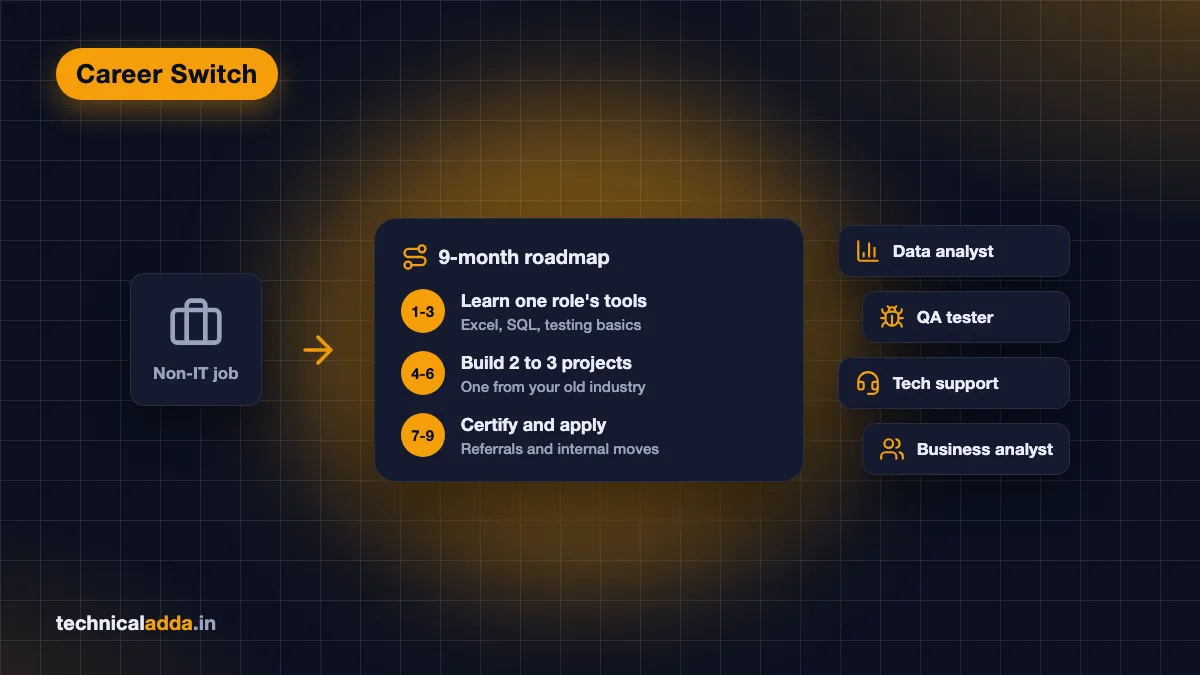
A career switch to IT is realistic in 2026 if you pick one entry role, study 10 to 15 hours a week for about 9 months while keeping your current job, and use your old industry as an advantage. The roles that hire switchers most readily are data analyst, software tester, technical support and business analyst. Skip any course that promises a guaranteed placement.
Most people who fail at this don't fail at coding. They fail because they quit their job too early, chase a "full stack plus AI plus cloud" syllabus, or never build anything an interviewer can see. This roadmap fixes those three mistakes, with real Indian salary data, course costs and a month-by-month plan.
Quick answer: To switch to IT from a non-IT background, choose one role that fits your current skills (data analyst, QA tester, technical support or business analyst), learn its core tools in 4 to 6 months, build 2 to 3 public projects, then apply using your domain experience as the hook. Keep your job until you have an offer.
Is a career switch to IT still worth it in 2026
Yes, but the easy version of the switch is gone. In 2015 a six-week Java course could land you a mass-hiring job at a services company. In 2026 recruiters want proof you can do the work, and AI tools have raised the bar for pure beginner coding roles.
The demand is still there. Naukri's JobSpeak report for February 2026 showed IT hiring up 6% year on year, with fresher hiring in IT up 8% and the strongest growth in AI and machine learning roles (Naukri JobSpeak, February 2026 (opens in new tab)). Companies are hiring, but more selectively.
What works in your favour as a switcher:
- Domain knowledge. A former bank officer who learns SQL understands loan data better than a fresh graduate. Fintech, insurance tech and healthcare IT teams pay for that.
- Work habits. You already handle deadlines, clients and email. Freshers have to learn that on the job.
- Many IT roles aren't pure coding. Testing, support, analysis and cloud operations reward careful thinking more than algorithm puzzles.
What works against you: you may take a salary cut for the first year or two, and you'll compete with graduates who have four years of CS on paper. The plan below is built around those two facts.

Most switchers keep their current job and study in the evenings until an offer comes through.
Best IT roles for career switchers
Pick one. Trying to learn data analytics, web development and cloud at the same time is the most common reason switchers are still "preparing" two years later.
| Role | What you do | Core skills | Coding level | Months to job-ready* | Indeed India average (all experience) |
|---|---|---|---|---|---|
| Data analyst | Turn business data into reports and answers | Excel, SQL, Power BI or Tableau, basic Python | Low to medium | 5 to 8 | about $6,600 a year |
| Software tester (QA) | Find bugs before users do, write test cases, automate tests | Manual testing, SQL, Selenium or Playwright, basic Java or Python | Low to medium | 4 to 7 | about $9,600 a year |
| Technical support engineer | Fix customer and internal tech issues | Networking basics, Linux, ticketing tools, clear writing | Low | 3 to 5 | about $7,600 a year |
| Business analyst | Translate business needs into requirements for tech teams | Requirements writing, SQL, Excel, process mapping, Jira | Low | 4 to 6 | about $9,400 a year |
| Front-end developer | Build websites and web app screens | HTML, CSS, JavaScript, React, Git | High | 8 to 12 | about $5,900 a year |
What is this in Indian rupees? Indeed India lists ₹6,29,449 (about ₹6.3 LPA) for data analysts, ₹9,08,191 (₹9.1 LPA) for software testers, ₹7,22,492 (₹7.2 LPA) for technical support engineers, ₹8,90,041 (₹8.9 LPA) for business analysts and ₹5,60,871 (₹5.6 LPA) for front-end developers. Dollar figures are converted at ₹95 per dollar.
*Months to job-ready is our estimate at 10 to 15 hours of study a week. Salaries are Indeed India averages for data analyst (opens in new tab), software test engineer (opens in new tab), technical support engineer (opens in new tab), business analyst (opens in new tab) and front-end developer (opens in new tab), pages updated 5 to 11 October 2026.
Read those salaries carefully. They average every experience level, so a switcher's first offer will usually be lower. The front-end number is based on only 78 reports, so treat it as rough.
Our pick for most switchers is data analyst. Almost every industry needs one, your old domain counts directly, and the tools (Excel, SQL, Power BI) are learnable in months. Software testing is the best pick if you're detail-oriented and want the shortest route into a product or services company. If you want to compare data roles with AI roles before deciding, read our data science course vs AI course guide.
Match the role to your background
Your past job decides which door opens fastest. Use this as a starting point.
| Your current field | Strongest IT target | Why it fits |
|---|---|---|
| Accounts, finance, CA/CS, banking | Data analyst or business analyst in BFSI | You already understand ledgers, loans and compliance data |
| Sales, customer service, BPO | Technical support, then cloud support or CRM admin | Customer handling is half the support job |
| Mechanical, civil, electrical engineering | Software testing (automation) or data analyst | Engineering logic and process thinking transfer well |
| Teaching | Software testing, technical writing or EdTech content | Explaining clearly and checking work carefully are core skills |
| Pharma, healthcare, lab work | Healthcare data analyst or QA in health tech | Domain rules (data privacy, trial data) are hard for outsiders |
| HR, recruitment | HR analytics or HR systems analyst | You know the processes the software has to support |
| Government exam aspirant (after a gap) | Data analyst or QA tester | Strong study discipline; no domain to lose |
The rule: aim for the IT job that sits closest to the industry you know. A pharma graduate applying to a pharma analytics team beats a generic applicant. A pharma graduate applying to a random web agency starts from zero.
Career change to IT at 30, 35 or 40
Age itself isn't the barrier. The salary reset and family responsibilities are.
At 30, you're a normal switcher. Plenty of entry-level IT hires are 26 to 30 after a master's degree or a gap. Your work experience makes you look more mature in interviews. Expect a first IT salary near the fresher-to-junior range for your role.
At 35, target roles where your experience counts in years: business analyst, functional consultant, product support lead, or a data analyst job in your old industry. A 35-year-old competing for the same generic tester job as 22-year-olds has a harder time.
At 40 and above, a full reset rarely makes sense. The smarter move is a hybrid role: an operations manager who learns Power BI and SQL and becomes the team's analytics lead, or a bank manager who moves into the bank's digital or IT project team. Internal moves are the most underrated route at every age.
Money planning before you start:
- Build an emergency fund of at least six months of expenses, including EMIs.
- Assume your first IT offer may be 20% to 40% below your current salary if you're switching fully (our estimate from typical entry ranges, not a survey).
- Don't resign to "study full time" unless you have a deadline, a fund and a backup. Most successful switchers study before work, after work and on weekends.

A mid-career switch is a staged move: keep your job, build skills, then step into the new role.
The 9-month career switch to IT roadmap
This plan assumes 10 to 15 hours a week alongside a full-time job: about 90 minutes on weekdays and 4 hours across the weekend. It's written for data analyst and software testing, the two most common targets. Adjust tools for your role.
- Month 1: Choose and set up. Pick your role from the tables above. Learn computer basics you may have skipped: files and folders, keyboard shortcuts, Google Sheets or Excel, and Git.
- Month 2: Core tool one. Data analyst: Excel to an advanced level (pivot tables, lookups, charts) and SQL basics. Tester: manual testing concepts, writing test cases and bug reports, SQL basics.
- Month 3: Core tool two. Data analyst: SQL joins, group by, window functions, then Power BI. Tester: one programming language (Java or Python) to loops, functions and classes.
- Month 4: First project. Data analyst: a dashboard on a public dataset from data.gov.in. Tester: manually test a real public website and publish a test plan with 30 to 50 test cases and bug reports.
- Month 5: Go one level deeper. Data analyst: Python with pandas for cleaning data. Tester: Selenium or Playwright to automate 10 of your earlier test cases.
- Month 6: Domain project. Build a project tied to your old industry, like a loan default analysis if you worked in banking, or a pharmacy inventory dashboard if you worked in pharma.
- Month 7: Certificate and polish. Finish one recognised certificate (see the next section), clean up GitHub, and write a one-page case study for each project.
- Month 8: Apply and practise. Rewrite your resume, practise SQL and scenario questions daily, and send 10 to 15 targeted applications a week.
- Month 9: Interview loop. Do mock interviews, follow up on referrals and keep building small projects so your GitHub shows recent activity.
Use AI tools throughout. Ask ChatGPT or Gemini to explain errors, quiz you on SQL, and review your project write-ups. Our AI skills to learn in 2026 list shows which AI skills recruiters now expect even in non-AI roles.
Courses and certificates worth paying for
A six-month Google certificate plus one NPTEL exam costs about $305 at Coursera's US price (much less in India, see below), and an optional AWS exam adds $100. Expensive bootcamps aren't required, and their placement promises are where most complaints come from. Fees below were checked in October 2026.
Free
- NPTEL / SWAYAM: IIT and IISc courses on Python, data analytics, software testing and cloud. Learning is free; the optional proctored exam has been about $11 per course in recent semesters, and a Jan to Apr 2027 semester is listed on NPTEL (opens in new tab).
- Kaggle Learn and freeCodeCamp: short free courses on Python, SQL, pandas and web basics.
- Microsoft Learn and AWS Skill Builder: free learning paths for Power BI and cloud fundamentals.
Low cost
- Google Data Analytics Professional Certificate (Coursera): 9 courses, about 6 months at 10 hours a week, beginner level, no degree or experience needed. It costs $49 a month at Coursera's US price after a 7-day free trial.
- Google IT Support Professional Certificate (Coursera): 6 courses, about 3 months at 10 hours a week, aimed at technical support roles.
- Coursera Plus: $59 a month or $399 a year at Coursera's US price, covering both Google certificates and many more. If you'll finish within six months, monthly billing is cheaper.
Paid exams
- AWS Certified Cloud Practitioner: $100 for a 90-minute, 65-question exam, with no prerequisites, per AWS (opens in new tab). Useful for cloud support and as a signal for any IT role.
- Microsoft PL-300 (Power BI Data Analyst): a 100-minute exam at $165 (Microsoft's US list price; it is priced by country, so check your local price when you schedule it). It's a strong add-on for data analysts once you've built two dashboards.
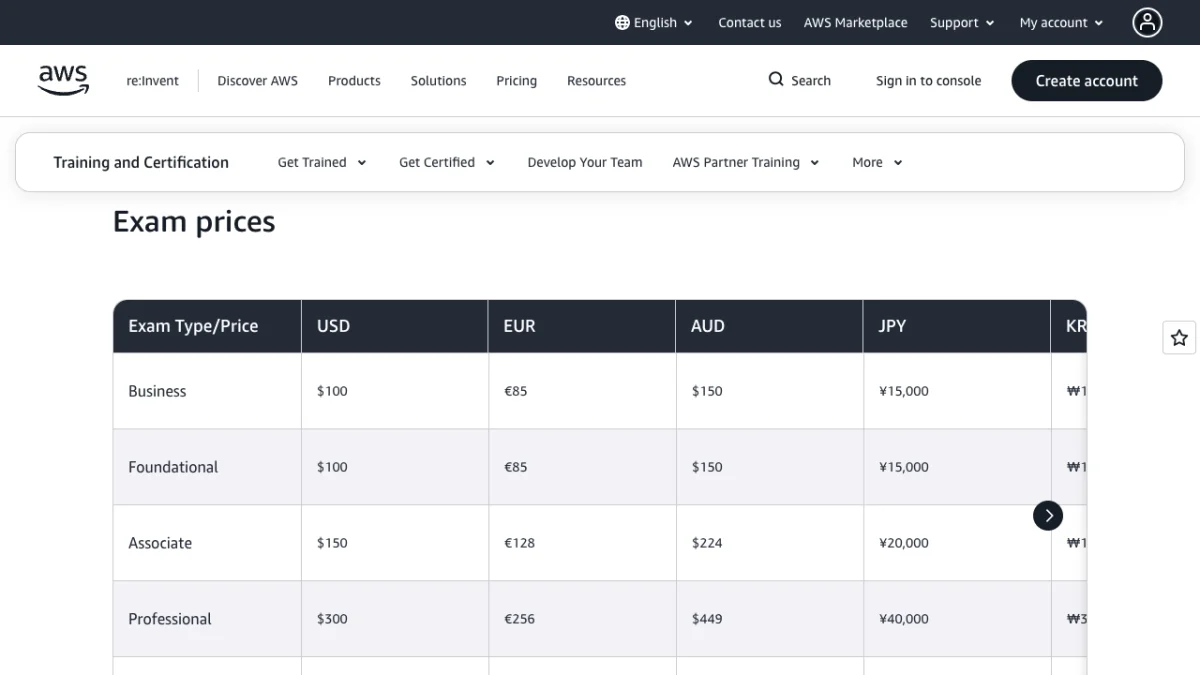
AWS lists its foundational exams, including Cloud Practitioner, at $100 and associate exams at $150.
What is the cost in Indian rupees? NPTEL's exam is ₹1,000. Coursera charges ₹1,888 a month for the Google certificate and ₹2,099 a month or ₹13,999 a year for Coursera Plus in India, so six months of Google plus one NPTEL exam is about ₹12,300. AWS lists ₹8,553 for Cloud Practitioner on the Pearson Mindhub voucher store, and Microsoft shows the PL-300 India price when you book through Pearson VUE.
A certificate gets your resume past the first filter. It doesn't get you the job. Projects and interviews do that.
Projects that get switchers shortlisted
Two or three finished projects that solve a real problem beat ten tutorial clones. Each one should have a short write-up: the problem, the data or app, what you did, and what you found.
| Role | Project idea | What it proves |
|---|---|---|
| Data analyst | Sales or loan dashboard in Power BI from a public dataset | SQL, data cleaning, business storytelling |
| Data analyst | Domain project from your old industry (anonymised or public data) | You understand the business, not only the tool |
| Software tester | Full test plan and bug report for a live public website | Test design, attention to detail |
| Software tester | Automation suite for that site in Playwright or Selenium on GitHub | Coding and automation basics |
| Technical support | Home lab: set up a Linux server, fix three staged problems, document each | Troubleshooting and clear writing |
| Business analyst | Requirements document and process map for an app you use daily | Requirements thinking and communication |
Host a simple portfolio page that links all of them. A free static host works fine; our Vercel vs Netlify comparison explains which free plan suits a personal portfolio.

Public projects give interviewers something concrete to ask about, which matters more than certificates.
Resume and job search for a mid career switch
Your resume has one job: make a recruiter believe you can do the IT role on day one. Lead with that, not with your old title.
- Headline: "Data Analyst | SQL, Power BI, Python | 6 years in retail banking", not "Assistant Manager, Branch Operations".
- Projects first, above work experience, with one line on the result of each.
- Rewrite old work in IT terms. "Built Excel reports for 14 branches, cutting month-end closing by two days" shows analysis skills you already used.
- Keep it to one or two pages. Our ChatGPT prompts for resume guide has prompts to rewrite each bullet.
Where to apply, in order of success rate for switchers:
- Internal moves inside your current company's IT, analytics or digital team. You skip the trust problem completely.
- Referrals from your college batch, LinkedIn connections and ex-colleagues who already work in tech.
- Domain companies: fintech for bankers, health tech for pharma people, edtech for teachers.
- Job portals like Naukri, LinkedIn Jobs and Instahyre, filtered to 0 to 2 years of experience in the new role.
Our AI jobs for freshers in India guide lists entry roles where AI skills give switchers an edge, with fresher salary ranges and where to apply.
Red flags and scams to avoid
Career switchers are the main target of aggressive edtech sales and fake job offers. Walk away from:
- "100% placement guarantee" with no written refund terms. Ask for the exact clause before paying.
- Pay-after-placement deals with hidden fees or a loan you sign on day one. Read the agreement in full.
- Jobs that ask you to pay for training, a laptop, verification or "registration". Real employers don't charge candidates.
- Offers from Gmail addresses or WhatsApp-only recruiters who skip interviews. Check the company's site and domain; our guide on how to check a fake website or link shows how.
- Salary claims without data. "Average package 8 LPA" (about $8,400 a year) means nothing without batch size and placement rate.
Before you pay for a bootcamp, finish one free course from the list above. If you can't finish a free course, an expensive one won't fix that.
The switch plan on one page
- Pick one role, study 10 to 15 hours a week for about 9 months, and keep your job until you have an offer.
- Data analyst, software tester, technical support and business analyst are the most realistic entry roles for non-IT people.
- Indeed India averages (October 2026, all experience levels): data analyst about $6,600, business analyst about $9,400, software test engineer about $9,600 a year (₹6.29, ₹8.90 and ₹9.08 LPA).
- Your old industry is an advantage. Target IT roles inside that domain first, including internal moves.
- The core toolkit is cheap: NPTEL is free (about $11 per exam), Google certificates on Coursera cost $49 a month (₹1,888 in India), AWS Cloud Practitioner is $100.
- Projects and a clear resume get you shortlisted; certificates alone don't.
Your first step this week
A career switch to IT in 2026 rewards focus over speed, so start by choosing one role this week. Make it one that sits close to the industry you know, give it about 9 months of steady part-time study, build two or three projects you can explain, and use internal moves and referrals before cold applications. Keep your job until the offer letter is signed.
Next, read our AI jobs for freshers in India guide to see which entry roles reward AI skills, and browse more in our AI careers section.
FAQ
Frequently Asked Questions
Can I switch to IT from a non-IT background?
Yes. Many Indian IT employees come from commerce, arts, mechanical or pharma backgrounds. Pick one entry role such as data analyst or software tester, learn its core tools in 4 to 6 months, and build two or three public projects. Recruiters care more about what you can show than about your degree.
Is 30 too late for a career change to IT?
No. Thirty is a common age for switching, and your work experience helps in interviews. The real challenge is that your first IT salary may be lower than your current one. Build a six-month emergency fund, keep your job while you study, and target roles in your current industry to reduce the pay gap.
Which IT job is easiest for a career switcher?
Technical support and manual software testing have the lowest entry barrier, with 3 to 7 months of preparation at 10 to 15 hours a week. Data analyst takes slightly longer but has more openings across industries. Front-end development is the hardest of the common entry routes because it needs stronger coding skills and faces more competition.
Can I get an IT job without coding?
Yes, in roles like technical support, manual testing, business analysis and IT project coordination. Basic SQL and Excel still help in almost all of them. In 2026, roles with zero technical skill are shrinking, so plan to learn at least SQL and one tool like Power BI or a test automation framework within your first year.
How long does a career switch to IT take?
For most people, 6 to 12 months from starting to study to receiving an offer, studying part-time alongside a job. That's roughly 4 to 7 months of learning and projects, then 2 to 4 months of applying and interviewing. Switching faster usually means studying full time, which carries financial risk.
Do I need a degree to get an IT job in India?
Most companies ask for a graduate degree in any stream, not specifically computer science. Some large IT services firms have rules on gaps or minimum marks, so check eligibility on their careers pages. Startups and product companies tend to focus more on skills, projects and interview performance than on degree type.
Is a career switch to IT worth it with AI taking jobs?
Yes, if you pick roles where AI is a tool, not a replacement. Data analysts, testers and business analysts who use AI to work faster are in demand. Naukri reported IT hiring up 6% in February 2026, with AI and ML roles growing fastest. Learn to use AI tools alongside your core skills.
Should I quit my job to switch to IT?
Usually not. Studying 10 to 15 hours a week while employed takes longer but protects your income and keeps your resume gap-free. Quit only if you have at least six months of expenses saved, a fixed study plan with a deadline, and a fallback if the job search takes longer than expected.
How much does it cost to switch careers to IT?
Often for about $305 at US prices, plus $100 if you add an AWS exam. NPTEL courses are free with an optional exam of about $11, Google's certificates on Coursera cost $49 a month at the US price, and the AWS Cloud Practitioner exam is $100. In India the same plan costs about ₹12,300 plus ₹8,553 for AWS. Bootcamps charging about $1,050 (₹1 lakh) or more are optional, and you should finish a free course before considering one.
Where to buy
-
Visit official site (opens in new tab)
the Google Data Analytics certificate
-
Visit official site (opens in new tab)
Coursera Plus