Data Science Course vs AI Course: Why Indian Beginners Should Start With Data
AI Careers 13 min read By Pragya Singh
In this articleTable of contents12
Last updated: 23 October 2026
In the data science course vs AI course debate, most Indian students should start with data science. It teaches Python, SQL, statistics and machine learning, which every serious AI course assumes you already know, and it leads to more entry-level jobs like data analyst. Pick an AI course first only if you can already code and want to build machine learning or GenAI products.
The confusion is that "AI course" means two very different things in India: a short course on using tools like ChatGPT and Gemini, or a long engineering course on building models. This guide compares both against data science on syllabus, maths, jobs, salaries and fees, then tells you what to pick based on your background.
Quick answer: Choose a data science course if you are a beginner, from a non-IT background, or want the widest set of entry-level jobs (data analyst, business analyst, junior data scientist). Choose an AI/ML course if you already know Python and statistics and want to become an ML or GenAI engineer. Choose a short AI tools course if you only want to use AI at work.
What each course actually teaches
Data science is the work of collecting, cleaning and analysing data to answer business questions and make predictions. A good data science course covers Python (pandas, NumPy), SQL, statistics, data visualisation, Excel or Power BI, and classic machine learning such as regression, classification and clustering.
Artificial intelligence is the broader field of building systems that can learn, reason or generate content. An engineering-level AI course covers machine learning, deep learning (neural networks), natural language processing, computer vision and, since 2023, large language models, prompt design, retrieval-augmented generation (RAG) and AI agents.
Machine learning sits in the middle. It is the part of AI that learns patterns from data, and it is also the advanced end of data science. That overlap is why both course types teach ML, and why people ask "AI or machine learning, which is better" as if they were rivals. They aren't. ML is a skill inside both.
Then there is a third type that sells under the "AI course" label: short courses on using AI tools at work, like Google AI Essentials on Coursera. These teach prompting and responsible use in a few hours (Google's takes under 5). They are useful, but they don't make you an AI engineer.

The two notebooks stand for the choice in this guide: data and statistics on one side, model building on the other.
Data science course vs AI course: side-by-side comparison
This table compares a typical data science course with an engineering-level AI/ML course and a short AI tools course.
| Point | Data science course | AI/ML engineering course | AI tools course |
|---|---|---|---|
| Core goal | Find answers and predictions in data | Build models and AI products | Use AI apps to work faster |
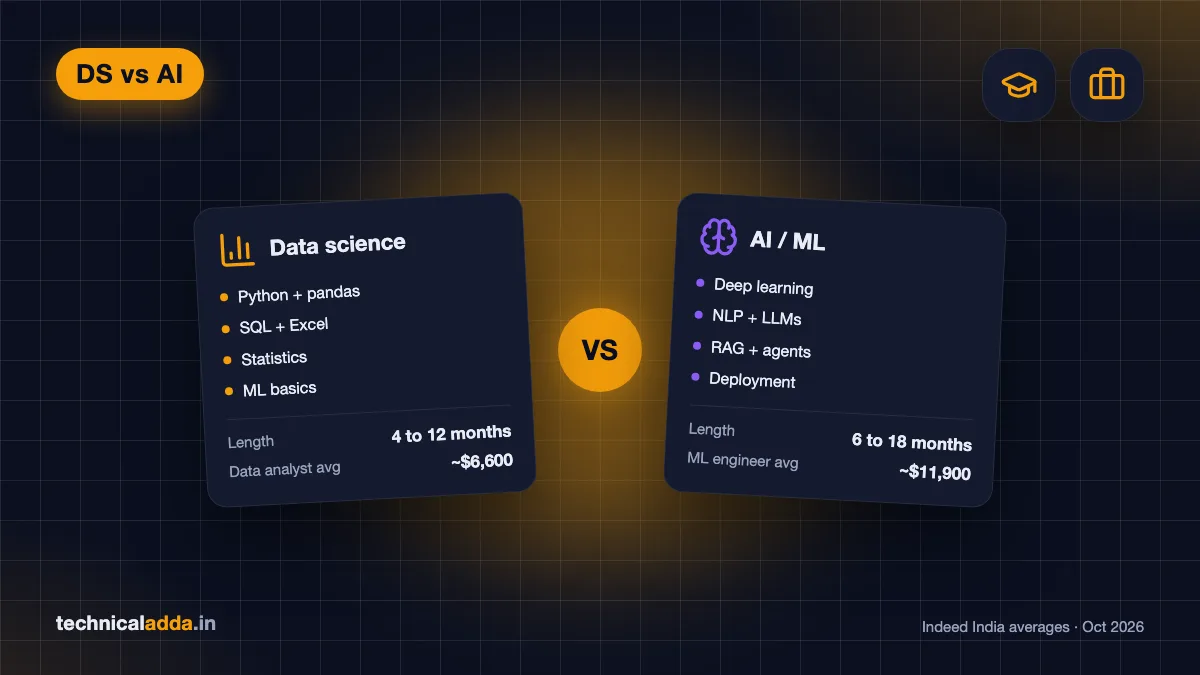
| Main skills | Python, SQL, statistics, Excel/Power BI, ML basics | Python, ML, deep learning, NLP, LLMs, RAG, deployment | Prompting, AI in docs and sheets, responsible use |
| Coding needed | Yes, from zero is fine | Yes, Python assumed | No |
| Maths level | Class 12 maths plus statistics | Linear algebra, calculus, probability | None |
| Typical length | 4 to 12 months | 6 to 18 months | A few hours to a few weeks |
| First jobs | Data analyst, business analyst, junior data scientist | ML engineer, GenAI developer, AI engineer | Your current job, done faster |
| Entry barrier for freshers | Lower | Higher | Lowest |
| Best for | Beginners, commerce and science grads, career switchers | CS/IT students, developers | Everyone, as an add-on |
The pattern: a data science course is the wider door, an AI/ML course is the deeper room behind it, and an AI tools course is a skill you add to any job.
How much maths you need
Less than YouTube comments suggest for data science, more than sales pages admit for AI.
For data science, Class 12 level algebra plus statistics (mean, median, standard deviation, probability, distributions, hypothesis testing) covers most analyst work. Coursera's IBM Data Science Professional Certificate says no prior programming knowledge is needed and that high school maths may help. Calculus and linear algebra are an asset only in its last few courses, not a requirement.
For machine learning, Andrew Ng's Machine Learning Specialization (opens in new tab) asks for high-school arithmetic and algebra plus basic coding (loops, functions, if/else) and explains the rest along the way. That is enough to start.
For deep learning and LLM engineering, you need matrix operations, derivatives and probability to understand why models behave the way they do. You don't need to derive formulas by hand, but you do need to read them.
If maths scares you, begin with statistics inside a data science course. Most people who "hate maths" hated how it was taught in school, not the logic of it.
Jobs and salaries in India
Data roles still outnumber pure AI roles at entry level, while AI roles pay more once you get in. Indeed India's salary pages, based on job postings and reported salaries across all experience levels, show this split:
| Role | Average base salary (per year) | Reported salaries | Indeed page updated |
|---|---|---|---|
| Data analyst | about $6,600 | 545 | 9 Oct 2026 |
| Machine learning engineer | about $11,900 | 51 | 28 Sep 2026 |
| Data scientist | about $12,800 | 308 | 8 Oct 2026 |
What is this in Indian rupees? Indeed India lists ₹6,29,449 (about ₹6.3 LPA) for data analysts, ₹11,34,488 (₹11.3 LPA) for ML engineers and ₹12,19,776 (₹12.2 LPA) for data scientists. Dollar figures above are converted at ₹95 per dollar.
Sources: Indeed India pages for data analyst (opens in new tab), machine learning engineer (opens in new tab) and data scientist (opens in new tab), checked 23 October 2026.
Two things to read from this. First, these are averages across all experience levels, so freshers usually start lower. Second, look at the sample sizes: data analyst salaries had ten times more reports than ML engineer salaries. That roughly mirrors how many more analyst jobs exist for beginners.
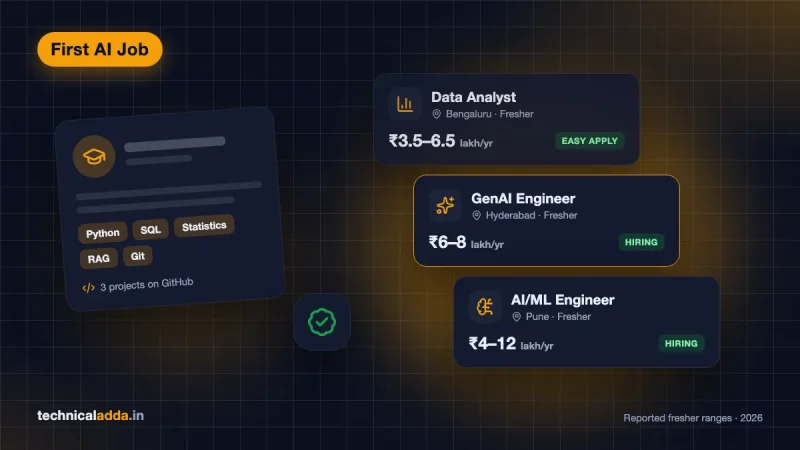
Our AI jobs for freshers in India guide lists typical fresher ranges by role and where to apply. The short version: a data science course gets you hired sooner, and an AI specialisation gets you paid more later.
Which one to pick by background
Your starting point matters more than which field sounds cooler. Here is what we'd suggest.
| Your background | Start with | Why |
|---|---|---|
| Class 12 student choosing a degree | Data science foundations (or IIT Madras BS foundation) | Builds maths, Python and stats you need for either path |
| BCom, BBA, BA graduate | Data science / data analytics course | Analyst roles value business sense; coding from zero is fine |
| BSc maths, stats or physics | Data science, then ML | Your maths is already an advantage |
| BTech CSE or IT student | AI/ML course (after a Python and SQL refresher) | You can handle the coding; GenAI projects stand out |
| Working developer | AI/ML or GenAI engineering course | Fastest route to AI engineer roles |
| Non-tech working professional | AI tools course now, data analytics later | Quick productivity win, then a skill that changes your role |
Data science vs data analytics: a data analytics course is the lighter version. It focuses on SQL, Excel, Power BI or Tableau and reporting, with little or no machine learning. It is the fastest route to a first data job. A data science course adds Python-based ML and modelling. If you are switching careers, analytics first and data science second is a sensible order.

Most people land a data analyst job first and move towards ML engineering once they can code well.
Course options and fees in India
You can learn either field for free, for under $100, or for several thousand dollars. Price doesn't predict quality. Here are options we'd consider, with fees checked on 23 October 2026.
Free options
- SWAYAM / NPTEL: IIT and IISc faculty teach Python, data science and machine learning courses. Learning is free; the optional proctored certificate exam is paid, so check the current fee on the course page. See NPTEL (opens in new tab).
- YUVA AI for ALL (IndiaAI): a free 4.5-hour government course on AI basics and responsible use of GenAI tools, with a participation certificate, on FutureSkills Prime. Good for absolute beginners.
- Kaggle Learn: short free courses on Python, pandas, SQL and intro to ML, with real datasets.
Our list of free AI tools for students pairs well with these if you want AI help while studying.
Certificates (under $250)
- IBM Data Science Professional Certificate (Coursera): 12 courses, about 4 months at 10 hours a week, beginner level, teaches Python, SQL and Jupyter.
- Machine Learning Specialization by Andrew Ng (Coursera / DeepLearning.AI): 3 courses, about 2 months at 10 hours a week. The best-known starting point for ML.
- Google AI Essentials (Coursera): 5 short modules on using AI tools and prompting, under 5 hours. An AI tools course, not engineering.
You can pay per course, or take Coursera Plus. Its price depends on your country; in India it works out to about $22 a month or about $147 a year, with a 7-day free trial on the monthly plan. Look for the "included with Coursera Plus" label on each course page before you subscribe. If you plan to finish the IBM certificate in 4 months, four monthly payments (about $88) cost less than the annual plan.. Coursera also offers financial aid on most courses.
Degree route
- IIT Madras BS in Data Science and Applications: open to anyone who has passed Class 12, in any stream and at any age, after a 4-week qualifier process. The Foundation level (8 courses, including maths, statistics and Python) costs about $505, Foundation plus one diploma about $1,360, and the full BS degree about $4,060 to $4,740, per the official academics page (opens in new tab). Indian learners with family income up to about $5,260 (₹5 LPA) a year get a 50% fee waiver, rising to 75% up to about $1,050 (₹1 LPA), with separate waivers for SC/ST and PwD learners. Its Diploma in Data Science even offers a deep learning and GenAI track, so you get both fields in one programme.
What is the cost in Indian rupees? Coursera Plus costs ₹2,099 a month or ₹13,999 a year in India (four months is ₹8,396). IIT Madras charges ₹48,000 for Foundation, ₹1,29,000 for Foundation plus one diploma and ₹3,86,000 to ₹4,50,000 for the full BS, with waivers up to ₹5 LPA family income. Dollar figures above are converted at ₹95 per dollar.

Course options run from free NPTEL lectures to paid certificates and a full IIT Madras degree.
BTech CSE vs AI and data science branch
Many Class 12 students face this at counselling: plain CSE, or a branch named "AI and Data Science" or "CSE (AI and ML)". Our view: if the college and fees are the same, plain CSE keeps more doors open, because it covers operating systems, networks and software engineering that AI branches sometimes trim.
The exception is when the AI branch is at a clearly better college than the CSE seat you can get. College quality, internships and your own projects matter more to recruiters than the branch name. You can learn every AI topic on top of a CSE degree through electives and the free courses above.
Before choosing, open the branch syllabus PDF on the college website and compare it with the CSE one, semester by semester. If the AI branch replaces core subjects with one-semester "intro to" papers, pick CSE.
Red flags in paid courses
Indian edtech ads are loud. Walk away if you see these:
- "100% placement guarantee" with no written refund terms. Ask for the exact clause in the agreement.
- Salary claims without data. "Average package 12 LPA" (about $12,600 a year) means nothing without the batch size, the share of students placed and the employer list.
- Pressure to take a loan today. No-cost EMI offers and "only 3 seats left" timers are sales tactics.
- No public syllabus or demo class. You should see every module and the tools used before paying.
- AI course that is only ChatGPT tips sold at engineering-course prices.
Before paying $1,000 or more for a bootcamp, finish one free course from the list above. If you can't finish a free course, an expensive one won't fix the motivation.
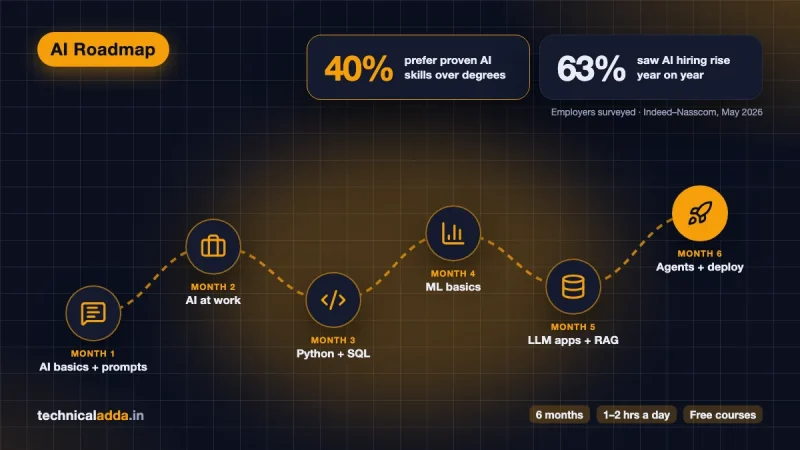
A 6-month plan that covers both
You don't have to choose forever. This order works for most beginners and keeps both doors open:
- Month 1: Python basics and Jupyter notebooks (Kaggle Learn or NPTEL).
- Month 2: SQL and Excel, plus one dashboard project on a public dataset from data.gov.in.
- Month 3: Statistics and pandas. Do a full analysis project and write it up on GitHub.
- Month 4: Machine learning basics (Andrew Ng's specialization or an NPTEL ML course).
- Month 5: Pick a lane. Data track: Power BI or Tableau, A/B testing, business case studies. AI track: deep learning basics, then build a small RAG chatbot over your own notes.
- Month 6: Polish 3 projects, write your resume and start applying.
For the AI track, our guide to run an LLM locally on your laptop is a good free project to add. When you build the resume, these ChatGPT prompts for your resume help with project descriptions. For a wider view of which AI skills employers want, read our AI skills to learn in 2026 roadmap.
What to settle before you pay any course fee
- In the data science course vs AI course choice, beginners and non-IT graduates should start with data science; CS students and developers can go straight to AI/ML.
- "AI course" can mean a 5-hour tools course or a year-long engineering course. Read the syllabus before you pay.
- Indeed India averages (October 2026): data analyst about $6,600, ML engineer about $11,900, data scientist about $12,800 a year (₹6.29, ₹11.34 and ₹12.2 LPA), across all experience levels.
- Good learning is cheap: NPTEL lectures are free, Coursera Plus is about $22 a month in India (₹2,099), and IIT Madras's Foundation level is about $505.
- Python, SQL and statistics are shared by both paths, so learning them first is never wasted.
- Projects on GitHub matter more to Indian recruiters than the name on the certificate.
So should you start with data or with AI?
Start with data. For most Indian students, the data science course vs AI course question ends the same way: learn data science foundations first, then specialise in AI. Python, SQL and statistics are the price of entry for both, and data roles give you a faster first job. Take an AI/ML course directly only if you already code, and treat short AI tools courses as a useful add-on, not a career.
Next, read our AI skills to learn in 2026 roadmap to plan your specialisation, and browse more guides in our AI careers section.
FAQ
Frequently Asked Questions
Which is better, data science or AI?
Neither is better for everyone. Data science is the better start for beginners because it teaches Python, SQL and statistics and leads to more entry-level jobs like data analyst. AI suits people who already code and want to build ML or GenAI products. Most AI engineers learned data science basics first.
Is AI harder than data science?
Yes, at the engineering level. AI and deep learning need stronger maths (linear algebra, calculus, probability) and solid Python. Data science needs Class 12 maths plus statistics, and many courses start from zero coding. Short AI tools courses are the easiest of all, but they teach you to use AI, not build it.
Can I learn AI without learning data science first?
You can, but you will struggle. Every machine learning course expects you to handle data with Python and pandas and to understand basic statistics. If you skip those, you end up copying code you don't understand. Spend two to three months on Python, SQL and statistics first, then move to ML.
Which pays more in India, data science or AI?
AI and ML roles usually pay more once you get in. Indeed India shows an average of about $11,900 (₹11.34 LPA) for ML engineers and about $12,800 (₹12.2 LPA) for data scientists, against about $6,600 (₹6.29 LPA) for data analysts, across all experience levels (October 2026). Freshers start lower, and analyst roles are easier to land first.
Can a commerce or arts student do a data science course?
Yes. Many data analysts in India come from BCom, BBA and BA backgrounds. You need Class 10 or 12 level maths and the patience to learn statistics and Python. Start with data analytics (Excel, SQL, Power BI), then add Python and ML. Business knowledge is an advantage in analyst interviews.
Is the IIT Madras BS in Data Science worth it?
It is one of the best value options in India. The Foundation level costs about $505 (₹48,000), the full BS about $4,060 to $4,740 (₹3.86 lakh to ₹4.5 lakh), and Indian learners with family income up to about $5,260 (₹5 LPA) get 50% to 75% fee waivers. It is rigorous, online, open to any age after a qualifier, and includes ML and GenAI electives.
Is data science dead because of AI?
No. AI tools automate parts of the job, like writing SQL or cleaning data, but companies still need people who frame the question, check the data and explain results. The data analyst role is shifting towards using AI tools well. A data scientist who knows LLMs is more employable than one who ignores them.
What is the difference between data science and data analytics?
Data analytics focuses on describing what happened, using SQL, Excel and dashboards in Power BI or Tableau. Data science goes further with Python, statistics and machine learning to predict what will happen. Analytics is the quicker route to a first job; data science opens more senior and ML-related roles.
Which free course is best to start data science or AI in India?
Start with Kaggle Learn's Python and pandas courses or an NPTEL Python course, both free. For AI basics, the government's YUVA AI for ALL course is free with a certificate. Once you finish one, move to Andrew Ng's Machine Learning Specialization on Coursera, which offers financial aid.
Where to buy
-
Visit official site (opens in new tab)
DeepLearning.AI courses
-
Visit official site (opens in new tab)
Google AI Essentials
-
Visit official site (opens in new tab)
Coursera Plus